
What Is Agentic AI? a Complete Guide for Business Leaders (2026)
Get answers to What Is Agentic AI? A Complete Guide for Business Leaders (2026). Learn to build secure operational systems for AI that acts on your behalf.
The biggest mistake leaders make with agentic AI is treating it like a better chatbot. It isn't. It's a new operating model for work.
That shift is already visible in the UK. Agentic AI became a board-level business topic after the UK Government's AI Opportunities Action Plan was published in January 2025, alongside a stated £100 million investment in the first phase of the agenda, signalling a move from experimentation towards operational adoption, as outlined in this UK-focused overview of agentic AI. If you run a business, that matters more than another model launch. It means autonomy is no longer a lab concept. It's becoming a management problem.
That's the right lens for What Is Agentic AI? A Complete Guide for Business Leaders (2026). The core question isn't “what can the model do?” The core question is “what will you allow it to do, under what controls, with what audit trail, and who is accountable when it acts?”
Table of Contents
- Agentic AI Is Here but Not How You Think
- From Goals to Guardrails Your Foundation for AI Autonomy
- Designing Your Agentic Project Workflow
- Activating and Delegating to Your AI Workforce
- Building the Command Centre for AI Operations
- Frequently Asked Questions on Agentic AI Governance
Agentic AI Is Here but Not How You Think
Agentic AI is not just software you prompt. It's software that can pursue a goal, break it into steps, use tools, and take action across systems with limited supervision. That makes it much closer to a digital employee than a search box.
Most executives still underestimate what changes when AI stops answering and starts doing. A chatbot can be wrong and waste time. An autonomous agent can be wrong and update a CRM, message a customer, trigger a workflow, or touch a regulated process. That is why the centre of gravity has moved from model quality to management discipline.
If you want a useful baseline definition before going deeper, Flaex has a concise agentic AI guide that helps distinguish agents from ordinary AI assistants. The useful leap for a CEO is to stop asking whether your team can use agents, and start asking how your company will supervise them.
The management challenge is the point
Traditional software gets configured. Human staff get managed. Agentic AI needs both.
That means leaders need a system for:
- Defining intent so the agent knows the business outcome it is meant to pursue
- Constraining behaviour so it can't roam across tools or data it shouldn't touch
- Reviewing actions so managers can see what was done, why, and with what result
- Escalating uncertainty so the agent pauses when the stakes are too high
Agentic AI doesn't remove management. It multiplies the need for it.
A lot of noise in the market focuses on interfaces. That misses the harder operational shift. The winning businesses won't be the ones with the flashiest demo. They'll be the ones that build an environment where AI can act safely, repeatedly, and under control. That future is already taking shape in products designed around action and orchestration, not just conversation, as explored in Zenfox's perspective on the future of agentic AI interface.
You are not buying intelligence alone
You are buying delegated action.
That means your evaluation criteria should change immediately. Don't ask only whether the agent sounds smart. Ask whether it can be governed. Ask whether its actions are permissioned, reversible, and visible. Ask whether you can explain to your board, regulator, and customers what it did.
If the answer is no, you don't have an enterprise AI capability. You have a liability.
From Goals to Guardrails Your Foundation for AI Autonomy
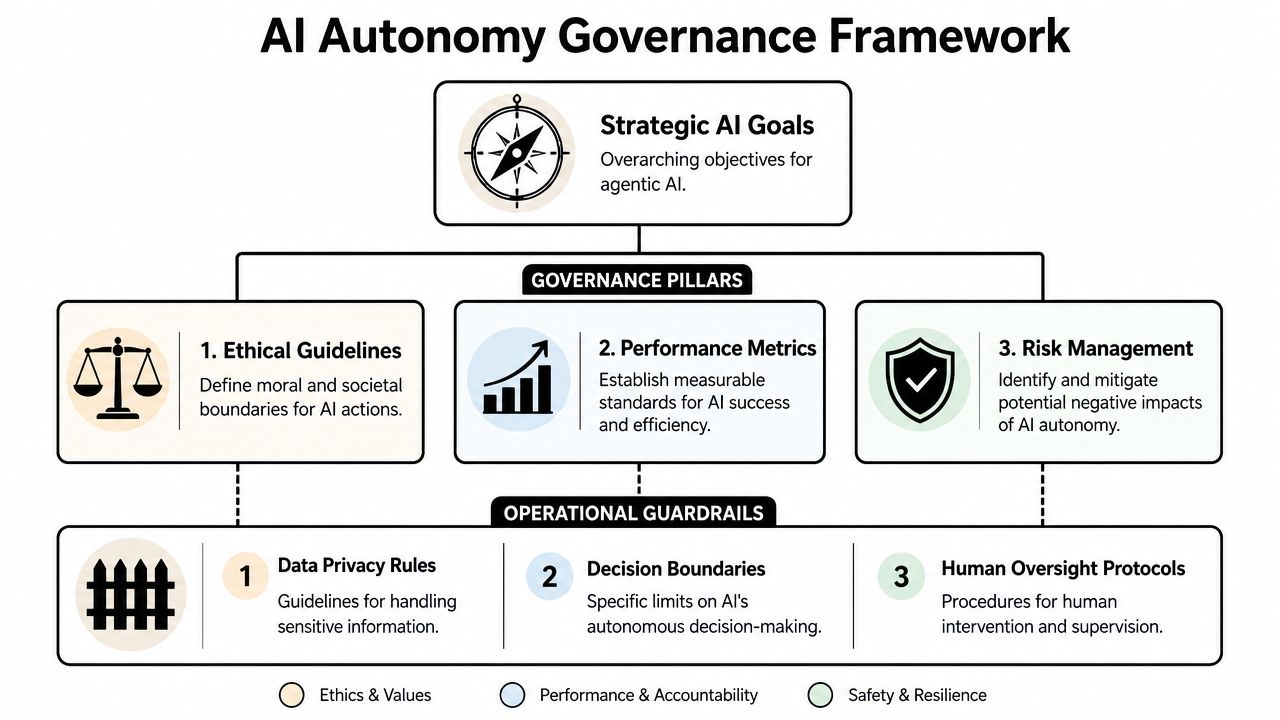
The primary challenge in agentic AI is not technical capability. It's governance.
That is the blunt truth most vendors soften because governance doesn't demo well. Yet for UK business leaders, the main implementation risk is not model capability but governance. Agentic AI must operate with explainable, auditable, permissioned, and reversible actions, supervised by humans who define intent, policies, escalation paths, and risk thresholds, as discussed in this analysis of governance in enterprise agentic AI.
Stop buying capability before defining control
Most AI projects fail long before the model does. They fail when leaders allow autonomy into a business process that has no clear owner, no escalation rule, and no action boundaries.
Build the command centre before you deploy the army. That means answering a few hard questions up front.
-
What outcome is the agent allowed to pursue A vague instruction like “improve sales follow-up” is useless. A defined instruction like “follow up on unanswered proposals sent last week using approved language and log every action” is operational.
-
What systems can it touch Reading from a knowledge base is not the same as writing into HubSpot, Jira, or your finance platform. Separate read access from write access.
-
When must it stop and ask for help An agent that never escalates is reckless. An agent that escalates every edge case is just expensive software. You need thresholds.
Practical rule: If you can't explain the permission boundary in one sentence, the agent should not have that permission.
Translate strategy into machine rules
Most executive teams need to get more concrete. Strategy lives in slide decks. Agents need machine-readable rules.
A workable governance baseline includes:
- Intent definition. What exact goal is the agent solving?
- Policy constraints. What language, offers, actions, and data uses are forbidden?
- Risk tiering. Which workflows are low-risk, medium-risk, or high-risk?
- Escalation logic. What conditions trigger human review?
- Audit design. What must be logged for every action and exception?
A good governance framework doesn't make agents weaker. It makes them deployable.
Your controls should be operational, not ceremonial
Boards like principles. Operations teams need controls.
Use controls that can be enforced:
- Permissioned actions with least-privilege access
- Reversible workflows where actions can be rolled back or corrected
- Human sign-off gates on sensitive steps
- Traceable decision paths that show what data the agent used
- Exception queues for ambiguity, policy conflicts, or failed tasks
If your governance exists only in policy documents, it won't survive contact with production.
Designing Your Agentic Project Workflow
Most firms choose their first agentic project badly. They either pick something trivial that proves nothing, or something politically sensitive that creates instant resistance. The right first projects sit in the middle. They matter, they recur, and they have clear boundaries.
Choose work that is structured, repetitive, and consequential
Start with workflows that already have a recognisable pattern across tools. Good candidates often involve email, CRM updates, document retrieval, status tracking, approvals, and follow-ups.
Poor candidates are usually ambiguous, high-drama, or very strategic. Don't let your first serious agent touch executive hiring, pricing exceptions, or disputed customer outcomes. Start where the organisation can learn to manage autonomy without betting the company on it.
A good test is simple:
- Is the goal clear
- Are the inputs identifiable
- Can success be checked
- Can the action be contained
- Can a human step in without chaos
Use prioritisation frameworks like an operator, not a consultant
Frameworks are useful if they force decisions. They're useless if they become workshop theatre.
Here is a practical comparison.
| Framework | Best For | Key Question for AI |
|---|---|---|
| Eisenhower Matrix | Sorting operational tasks by urgency and importance | Should an agent handle this in the background so people can focus on urgent exceptions? |
| RICE | Comparing several automation opportunities across a portfolio | Which workflow is worth deploying first given likely impact, confidence, and implementation effort? |
| MoSCoW | Defining scope for an initial rollout | What must be automated now, what should wait, and what should stay human? |
Use Eisenhower when your teams are overloaded with admin and follow-up work. Use RICE when you have competing automation candidates across departments. Use MoSCoW when product, operations, and compliance need to agree on what the first release will and won't do.
The first win in agentic AI is rarely the most glamorous task. It's the task your team is tired of doing, keeps delaying, and can't afford to keep forgetting.
If you're evaluating how to build and structure these automations, Zenfox has a useful look at the AI agent builder approach for turning plain-English goals into multi-step workflows.
Design the workflow as four cooperating agents
A practical rollout model is to split the system into four layers: a Planner Agent, Retriever Agent, Executor Agent, and Verifier Agent, as described in this four-layer architecture for agentic AI. This design compels clarity.
Planner Agent
The planner converts a business goal into a task graph. It decides the sequence, dependencies, and order of operations.
Retriever Agent
The retriever pulls approved data from internal and external sources. It should not improvise its own source universe.
Executor Agent
The executor writes into operational tools such as CRMs, ticketing systems, or databases. This is where real-world consequences start.
Verifier Agent
The verifier checks policy, quality, and completion before final output. This is not optional. It is your brake pedal.
That architecture is far better than one giant “do everything” agent. It makes ownership clearer, testing easier, and failures easier to isolate.
Activating and Delegating to Your AI Workforce
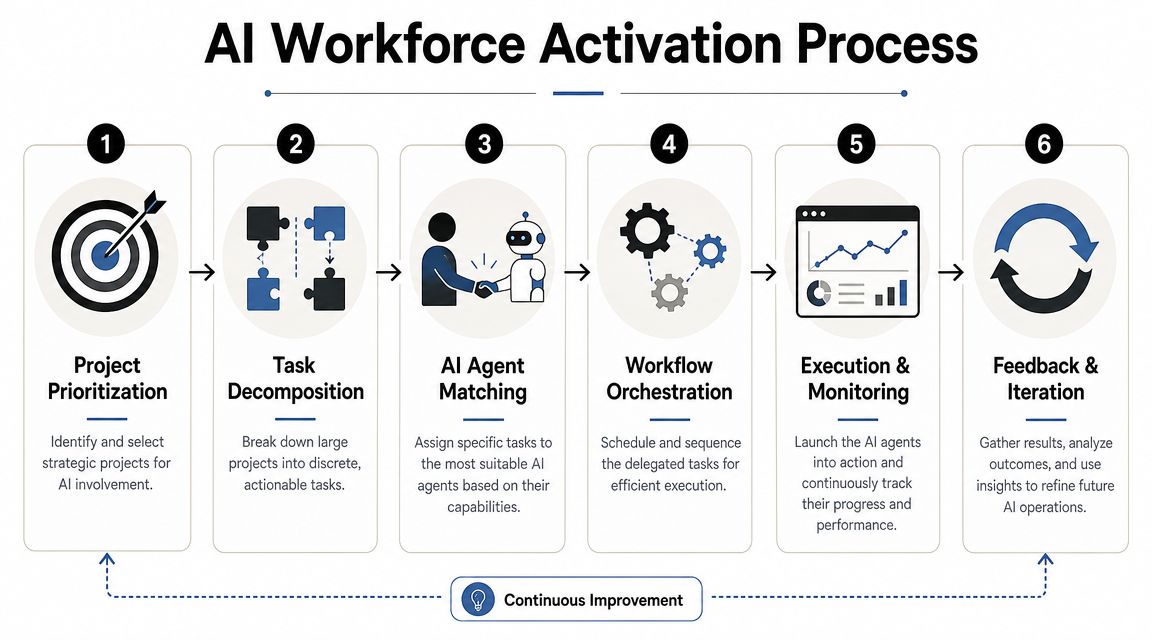
Once the workflow is selected and the guardrails are set, the next step is delegation. At this stage, most companies either achieve significant advantage or create expensive confusion.
UK adoption conditions already explain why this is accelerating. The Office for National Statistics has reported that a substantial share of UK firms already use AI, especially larger enterprises and faster-growing sectors such as information and communications and professional services. Separately, DSIT has reported that AI could add up to £400 billion to the UK economy by 2030, according to this overview of AI agents and UK adoption. That projection matters because it pushes leaders to move from curiosity to operating discipline.
A practical delegation example
Take a common revenue workflow. Sales has sent proposals. Some prospects haven't replied. Reps are busy, follow-up discipline slips, and pipeline hygiene degrades.
A well-governed agentic workflow can handle this.
A user gives a plain-English goal such as: follow up on all proposals sent last week that haven't received a reply.
The workflow then breaks into actions like these:
- Search Gmail for relevant sent proposals.
- Cross-check the CRM for reply status and account context.
- Draft a follow-up email using approved messaging.
- Send only if the contact falls within policy rules.
- Log the action in the CRM.
- Escalate unusual cases, such as pricing disputes or legal objections.
One factual product example illustrates this. Zenfox.ai is built for this kind of cross-tool execution. It connects systems such as Gmail, Slack, HubSpot, and Drive, lets users describe goals in plain English, and keeps a complete activity log while carrying out multi-step workflows. That's the right shape for agentic operations because it combines action with traceability.
What good activation looks like
Don't treat delegation as “set and forget”. Treat it like assigning a capable new operator.
Good activation includes:
- A named owner for the workflow
- A trigger that starts the task predictably
- A bounded action set with defined permissions
- A review path for exceptions
- A logging standard for every step taken
Bad activation looks different. It sounds like “let's connect the tools and see what happens”. That mindset works for sandboxes. It fails in live operations.
A useful way to calibrate your ambition is to study adjacent use cases where agents coordinate complex steps across environments. Applied's example of Langchain AI for logistics automation is worth reviewing because it shows what multi-step orchestration looks like when the workflow is operational rather than theoretical.
Delegation is successful when the agent handles routine flow and humans handle exceptions, judgment, and accountability.
Building the Command Centre for AI Operations
Agentic AI without central oversight creates operational risk at machine speed.
Once agents can trigger workflows, touch records, message customers, or update systems, you need a control plane that management can use. This is not a technical nice-to-have. It is a management system for autonomy.

A serious command centre shows leaders four things at once. What agents are doing, what they are allowed to do, where risk is rising, and when a human must step in. Zenfox's write-up on Mission Control for AI operations oversight is a useful example because it treats agent management as live operations, not a prompt experiment.
That operating view matters most when systems become interconnected. As systems grow more complex, control failures rarely come from one dramatic error. They come from small interactions across tools, permissions, and dependencies, a point reflected in Faberwork LLC's latest thinking.
Your command centre needs three layers
Start with activity visibility. Every meaningful action needs a timestamp, tool reference, data context, and a plain-English explanation of what changed. If a COO asks why a customer record was updated or why a task stalled, the answer should be available in minutes.
Then build risk detection. Good oversight catches policy violations, unusual access patterns, repeated failures, and actions outside approved sequences before they spread across the business. Drift is a management problem. Your command centre must surface it early.
Then enforce review cadence. Weekly operational reviews beat annual governance theatre. Inspect exceptions, approvals, failed runs, and override rates on a set rhythm, with named owners and clear follow-up actions.
A practical command centre tracks:
- Task status across running, completed, failed, and escalated work
- Exception patterns that expose weak workflows or poor policy design
- Dependency health across APIs, apps, and data sources
- Human interventions that show where autonomy still needs tighter limits
- Access events tied to sensitive systems, records, or action types
Here's a useful short explainer on how operational oversight should feel in practice.
Review agents like you review managers
Executives who only review outputs miss the underlying failure point. You need to review operating behaviour.
Ask questions that change decisions:
- Where does the agent fail more than once
- Which workflows create the most overrides
- Which actions trigger downstream cleanup
- Which permissions are too broad
- Which processes are ready for more autonomy
- Which processes need tighter approval gates
Good AI operations are quiet. Tasks complete. Logs are readable. Exceptions surface fast. Accountability is obvious.
If your agent layer depends on constant manual checking, scattered alerts, and unclear ownership, you do not have scale. You have a fragile pilot.
Frequently Asked Questions on Agentic AI Governance
Agentic AI becomes a management problem the moment it can act. Definitions stop mattering at that point. Decision rights, approval limits, logging, and accountability decide whether you get scale or a costly mess.
Who is responsible when an agent makes a mistake
The company is responsible. The executive who owns the process is responsible for the business outcome.
Do not let accountability disappear into a vendor contract, a model provider, or an automation team. If an agent sends the wrong customer communication, updates the wrong record, or takes an action outside policy, leadership owns the failure. Technology may have triggered it. Management allowed it.
Set ownership before deployment:
- Business owner for outcome, policy, and commercial impact
- Technical owner for workflow logic, integrations, and failure handling
- Risk or compliance owner for approval thresholds, review cadence, and controls
If one of those roles is missing, stop the rollout.
How should UK businesses govern high-risk uses of agentic AI
Start with the decision, not the model.
If a workflow can affect employment, credit, legal rights, pricing fairness, or vulnerable customers, treat it as high risk from the start. The UK position has not created one new AI rulebook that replaces everything else. Existing sector rules still apply, and high-risk personal data processing can trigger DPIA requirements under the Information Commissioner's Office framework, as outlined in IBM's discussion of AI agents and governance boundaries.
That means your governance model has to map each agent workflow to an existing control structure:
- What decision is being made
- Which regulation or internal policy applies
- What evidence must be logged
- When human approval is required
- Who can stop the workflow
This is why agentic AI should be treated as an operating model change, not a software feature.
How do you give an agent access to sensitive data safely
Use scoped access tied to the task. Broad permissions are lazy governance.
A retrieval step may need read access to a narrow dataset. An execution step may need limited write access in one system. Those permissions should not be bundled together by default.
Set these controls:
- Separate read and write permissions
- Restrict access to approved systems and data domains
- Log every sensitive action and approval
- Review permissions on a fixed schedule
- Keep rollback paths for reversible changes
Zenfox.ai is a good example of the right operating approach. It lets teams run action-taking AI workflows across tools while keeping permissions, workflow visibility, and audit trails under control.
When should an agent act and when should it only recommend
Use a decision matrix. Do not rely on instinct.
Automatic action fits low-risk, high-volume, rules-based work where errors are reversible and evidence is easy to inspect. Recommendation-only mode fits decisions with regulatory exposure, reputational impact, or meaningful customer harm.
A simple rule works well:
- Auto-act on routine operational tasks with tight policy boundaries
- Require approval for exceptions, threshold breaches, or external communications
- Recommend only for high-stakes decisions involving rights, money, safety, or vulnerable groups
For leaders handling risk as systems become more interconnected, Faberwork LLC's latest thinking is useful because it shows the same operational truth. As systems gain autonomy, unmanaged interactions create the biggest failures.
What is the right first move for a CEO
Choose one workflow with measurable value, clear ownership, and tolerable downside if it fails. Then insist on controls from day one.
Do not start with an enterprise-wide assistant strategy. Start with a contained delegation problem such as intake triage, exception handling, or internal service operations. Require approval rules, action logs, rollback options, and named owners before the first live run.
Teams that get this right treat agentic AI as a governed workforce. Teams that get it wrong treat it as a demo.
If you want to put agentic AI to work without losing control of it, look at Zenfox.ai. It's designed for teams that need AI to take real actions across tools while keeping workflows visible, auditable, and manageable.