
How to Improve Sales Productivity: A 2026 Playbook
Learn how to improve sales productivity with a 30-day reset: baseline selling hours, five KPIs, exit-criteria stages and approved automation workflows.
Only 41.2% of UK small and medium-sized businesses reported increased sales in 2024, down sharply from 59.6% in 2023, according to the Department for Business and Trade Small Business Survey 2024 panel report. When commercial growth tightens like that, most sales leaders pull the same two levers: they demand higher call volumes and they police the CRM harder. Neither fixes the floor. Reps log busier weeks, pipeline counts swell with polite "maybe later" conversations, and closed revenue barely moves.
Working out how to improve sales productivity requires a different starting assumption. Productivity on a small UK sales team comes from reclaimed selling capacity and clean stage data, not from squeezing more outbound activity out of exhausted reps. Adding headcount is expensive, and buying another standalone dashboard only gives everyone another tab to ignore before Friday's forecast call.
I would start by stripping away the repetitive admin that eats the working week, tightening the evidence required to move a deal forward, and measuring the handful of numbers that expose real bottlenecks. Automation has a clear place in that rebuild, provided it follows one strict boundary: let software reconstruct context and draft routine updates, and keep a human approving every risky commercial step.
Table of Contents
- Where Your Selling Week Actually Goes
- Build a Process With Exit Criteria at Every Stage
- The Scorecard That Shows Real Improvement
- Automate the Admin and Approve the Risky Bits
- Run the Reset in Four Weeks
- What to Fix When the Numbers Stall
- Choose One Metric and One Workflow to Start
Where Your Selling Week Actually Goes
Before changing targets or rewriting scripts, look at where a rep's hours disappear. In 2025 Salesforce research cited by the Ell Advisory Admin Tax Index, the 250 UK respondents inside a 4,050-person global sample reported spending only about 40% of their working week selling, while 60% went to non-selling tasks. That breakdown split into 22% on customer meetings, 18% prospecting, 17% creating quotes, 16% planning, and 13% manually entering data, leaving 14% for other administration and training. Because those figures come from vendor research rather than a controlled UK study, treat them as directional rather than exact law, yet they match what shows up on almost every small sales floor when you audit calendars.
That split reframes the entire job. If your sellers spend three days out of five on quoting, internal planning, and retyping notes, telling them to dial faster won't move the needle. Real productivity means reclaiming customer-facing capacity and routing it into live buying conversations.
Applying those percentage shares to a standard 37.5-hour UK working week shows exactly where automation has impact and where human time needs protection.
| Activity | Share of a 37.5-hour week | Automation leverage | What reclaims the time |
|---|---|---|---|
| Customer meetings | 22% (8.25 hours) | Low | Protect the time; shorten prep with automatic pre-meeting briefs |
| Prospecting | 18% (6.75 hours) | Medium | Verified account lists and sequenced first touches |
| Creating quotes | 17% (6.38 hours) | High | Quote templates populated from CRM fields and approved pricing |
| Planning | 16% (6.00 hours) | Medium | Automated weekly briefs and blocked selling time |
| Manual data entry | 13% (4.88 hours) | High | Meeting capture drafted into CRM for one-click approval |
| Other admin and training | 14% (5.25 hours) | Medium | Written playbooks and searchable internal answers |
Notice where the most productive hours sit. Creating quotes and typing CRM updates eat 30% of the week combined, roughly 11.25 hours per rep, without persuading a single buyer. Cutting duplicated work in those two buckets returns more selling capacity than any time-management workshop ever could.
Three Diagnostic Questions for Any Sales Week
Numbers from a survey only tell you where to look; they don't tell you which task is choking your specific team. Run three blunt questions against every recurring job on a rep's calendar before you touch a single tool.
- Does this task repeat weekly without changing a buyer's decision? Rebuilding pricing spreadsheets from scratch, reformatting standard proposals, and copying contract details between systems usually fail this test immediately.
- Does this task exist only to reconstruct context that already sits in email or a call recording? When reps spend twenty minutes after every discovery call summarising what was already captured in Gmail, HubSpot, or a call transcript, you're paying skilled sellers to do transcription.
- Could a manager solve this once and remove it for everyone? If five reps spend two hours every Monday hunting down approved case studies, current pricing tables, or competitor comparisons, one shared folder or automated brief removes ten hours of collective drag in a single afternoon.
Capacity rule: Judge every process change and automation tool by three numbers together, namely selling hours recovered, CRM completeness, and qualified pipeline or revenue per selling hour, never by message volume or login counts.
The One-Hour Baseline Exercise
You don't need tracking software to measure your starting point. Ask every rep to keep a simple tally across five working days using those core buckets: customer meetings, prospecting, quoting, planning, manual data entry, and other admin. It takes roughly ten minutes at the end of each day, under an hour across the full week.
On Friday afternoon, compare each person's totals against the table above. Whatever bucket shows the widest gap between hours consumed and commercial value produced becomes your first operational target. For solo sellers and small UK teams where hiring another rep isn't on the table, clawing back four or five hours a week per person is the closest thing to free headcount you'll ever get.
Build a Process With Exit Criteria at Every Stage
Reclaimed selling hours go to waste if reps spend them chasing deals that will never close. Most small teams run a pipeline built on optimism: a prospect agrees to a second call, so the rep drags the card into Discovery, attaches a rough value, and calls it forecast. Without shared stage definitions, two reps in the same office can put identical opportunities in completely different columns.
A disciplined process replaces optimism with verifiable evidence at every transition, starting from initial target account selling right through to signed handover.
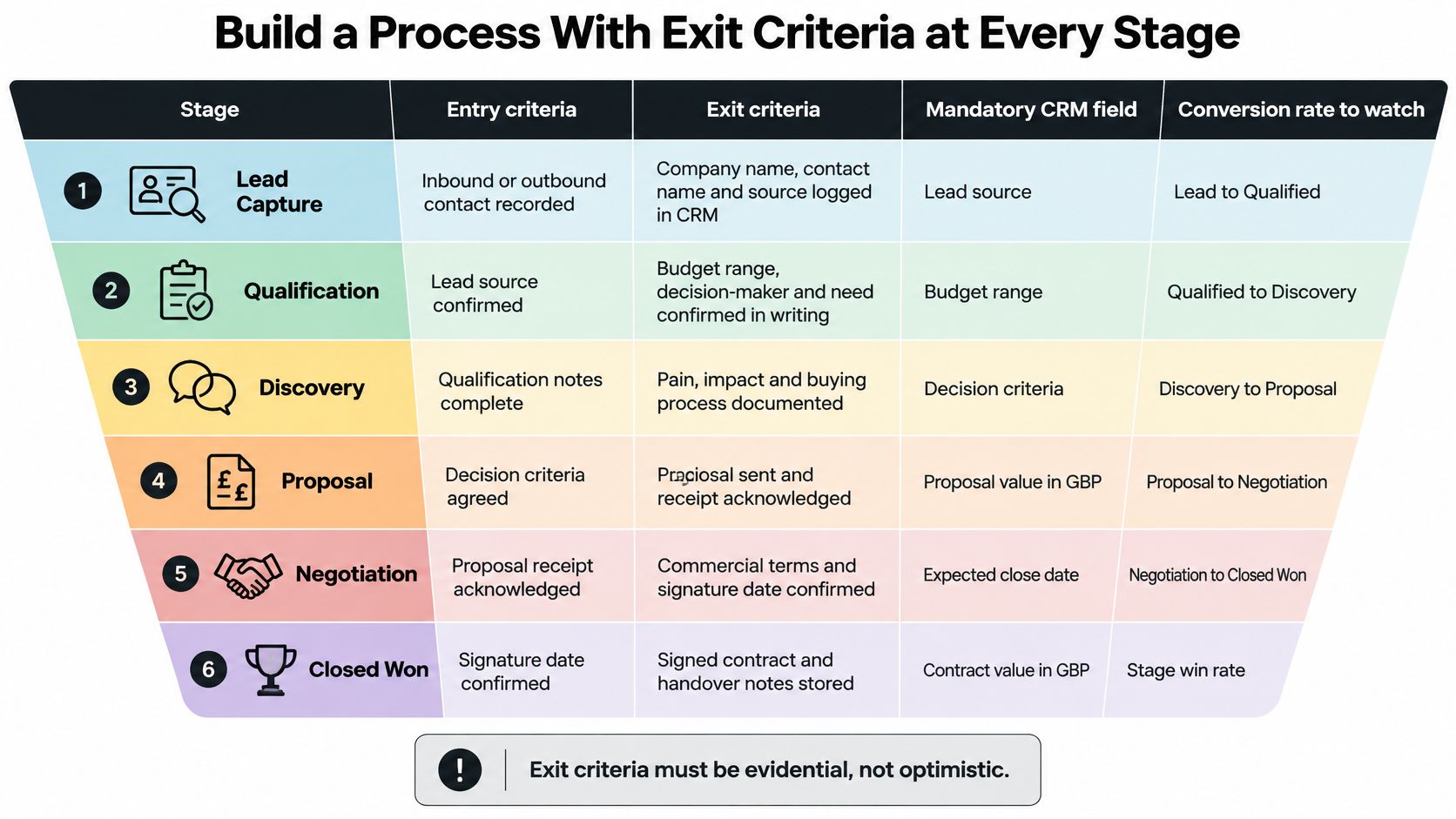
Every open opportunity needs four essential fields regardless of stage: a named owner, a dated next action, an expected close date, and a realistic deal value. On top of those basics, each stage carries clear entry conditions, evidential exit criteria, and one mandatory CRM field that locks the transition.
| Stage | Entry criteria | Exit criteria | Mandatory CRM field | Conversion to track |
|---|---|---|---|---|
| Target account | Named buyer persona and a reason to contact now | Contact identified at the account | Account tier | Target accounts contacted ÷ total |
| Qualified opportunity | Problem, budget range and timeline evidence | Buyer confirms the problem and a rough budget | Expected value | Contact to qualified |
| Discovery | Qualified opportunity accepted | Named economic buyer, dated problem, decision criteria, budget range | Next action and date | Qualified to discovery |
| Proposal | Discovery exit met and solution agreed in outline | Decision criteria confirmed and approval chain mapped | Expected close date | Discovery to proposal |
| Negotiation | Proposal delivered and reviewed by the buyer | Commercial terms agreed in writing; legal and pricing approved | Discount % | Proposal to negotiation |
| Closed-won | Contract signed and purchase order raised | Handover completed with onboarding date agreed | Onboarding date | Negotiation to closed-won |
Making Exit Criteria Evidential Instead of Optimistic
The single fastest way to clean up a noisy CRM is to make every exit criterion a documented buyer action rather than a rep's feeling. Discovery doesn't end because the call ran long and sounded friendly; it ends when a named economic buyer, a dated commercial problem, explicit decision criteria, and a budget range are logged in the record. Proposal doesn't end when you email a PDF; it ends when the buyer confirms the evaluation criteria and you've mapped who signs the purchase order.
Negotiation demands the strictest gate of all. A deal stays in Negotiation until commercial terms are agreed in writing and both pricing and legal have signed off internally. Keep one short, written definition per stage in a shared document that every rep uses, so a "Proposal" deal means the exact same thing across the entire floor.
Segmenting Conversion to Spot the Real Constraint
Tracking closed revenue on its own tells you what happened last quarter, not where deals are leaking today. A UK sales-performance methodology published by SalesSense recommends measuring contacts, pipeline value, new customers, and stage-by-stage conversion ratios so every stage acts as an inspectable control point. It also highlights why comparing yourself against averages sets the bar too low: in 2022, employees in firms at the 90th percentile of UK labour productivity generated 3.59 times the output of employees at the median.
Apply that same top-decile mindset inside your own funnel. Every week, calculate conversion rate and median cycle time at each stage, then slice the numbers four ways:
- By representative: Separates individual skill gaps, such as strong outbound prospecting paired with weak discovery, from team-wide friction.
- By acquisition channel: Reveals whether inbound enquiries convert cleanly while purchased lists stall right after qualification.
- By customer sector: Surfaces vertical-specific compliance or procurement hurdles that drag proposal-to-close timelines out.
- By deal size: Shows where larger contracts stall waiting on commercial or legal approval while smaller deals sail through.
When one segment converts briskly and another collapses at the exact same stage, you've found a process or targeting constraint rather than a motivation problem. Benchmark each stage against your own strongest historical quarter and your top-decile performers, then focus coaching and workflow fixes squarely on the sharpest drop.
The Scorecard That Shows Real Improvement
Once stage definitions hold steady, you need a scorecard tight enough to review in twenty minutes every Monday morning. Most CRM platforms ship with forty-metric dashboards that look impressive during a software demo and gather dust by week three. Managers drown in charts, reps ignore the whole screen, and coaching drifts back to gut feel.
Paste the seven-row scorecard below straight into a spreadsheet or a single CRM view. Five rows run weekly because they flag friction while you can still rescue the quarter; two run monthly because they need a meaningful batch of closed deals before the numbers settle.
| Metric | How to calculate | Review | Healthy signal | Warning sign |
|---|---|---|---|---|
| Selling hours per rep per week | Customer-facing hours logged ÷ number of reps | Weekly | Trending above baseline each month | Hours fall while activity counts rise |
| Qualified opportunities created | Opportunities meeting entry criteria ÷ reps | Weekly | Stable or rising month on month | Volume up, qualification evidence down |
| Stage conversion rate | Deals leaving a stage ÷ deals entering it | Weekly, by stage | Steady or improving against your best quarter | Any single stage halving |
| Sales-cycle length | Median days from qualified to closed-won | Monthly | Shortening while win rate holds | Shortening with a falling win rate |
| Follow-up completion | Follow-ups done on time ÷ follow-ups due | Weekly | 90% or higher | Overdue follow-ups piling up on live proposals |
| CRM completeness | Open opportunities with owner, next action, value and close date ÷ all open | Weekly | Every open deal has all four fields updated | Clean only the day before forecast |
| Revenue per selling hour | Closed-won revenue ÷ logged selling hours | Monthly | Rising two quarters running | Flat while headcount grows |
Why Disciplined Measurement Beats Activity Policing
Structured management routines aren't bureaucratic theatre; they're directly tied to commercial output. An Office for National Statistics analysis of British production and services firms found statistically significant links between labour productivity and practices including continuous improvement, monitoring KPIs, target-linked performance bonuses, and formal promotion systems. After controlling for other business characteristics, a 0.10 increase in a firm's management-practice score was associated with a 9.6% increase in productivity, echoing earlier ONS findings where a 0.10 gain aligned with an 8.6% labour-productivity lift and management practices explained roughly 8% of productivity variation between businesses.
Translating that evidence onto a small sales floor is straightforward. Define a tight set of commercial outcomes, inspect them on a fixed rhythm, and use the data to locate process bottlenecks rather than to publicly rank reps.
In each weekly one-to-one, open the rep's own seven rows and pick the single weakest reading. Agree one concrete adjustment for the next five working days, such as tightening discovery qualification or clearing overdue proposal touches, then check whether the row moved the following Monday. Clean weekly discipline here also underpins a dependable sales forecasting methodology, because leadership stops guessing which late-stage deals are real.
Vanity Metrics to Cut Immediately
If a metric can rise while revenue drops, take it off the main scorecard. Four culprits waste the most management attention on UK sales teams:
- Raw emails sent: Rewarding send volume encourages templated blasts that burn domain reputation and annoy good-fit buyers.
- Calls logged: High dial counts often hide poor list quality, wrong numbers, and rushed voicemails that generate zero pipeline.
- CRM login counts: Logging in every morning proves someone opened a browser tab, not that deal records are accurate or up to date.
- Unqualified pipeline volume: Celebrating newly created deals without entry evidence inflates coverage ratios and guarantees an ugly end-of-quarter miss.
Stick to the one-page rule: put three priority metrics on the team view, assign one named owner to each, and review them every Monday without fail.
Automate the Admin and Approve the Risky Bits
Most CRM compliance drives fail because leaders treat a workflow-design problem as a discipline problem. A UK compilation from Ell Advisory citing Salesforce field-sales data notes that field sales reps spend roughly 28% of their working week selling, with CRM administration, quoting, meetings, and travel consuming the remainder. Asking those reps to spend even more time manually logging notes only breeds resentment and patchy data.
At the same time, handing an unchecked bot full write access to your CRM and outbound email destroys buyer trust and creates real compliance risk under UK GDPR. The operational rule is blunt: automate the reconstruction of context, never the commercial judgement.
Five focused workflows cover most of the administrative drag on a small UK sales team, and every one of them can ship inside a week with a clear human approval boundary.
| Workflow | Trigger | What the automation does | Human approval point |
|---|---|---|---|
| Stale-opportunity sweeper | No next action or expected close date passed | Checks the record against stage exit criteria, requests the missing evidence, compiles a weekly exception report | Any change to value or close date |
| Meeting-to-CRM capture | Calendar meeting ends | Drafts the summary, extracts the next action and proposes field updates | Before anything is written into the CRM |
| Follow-up sequence | Proposal sent, no reply within three working days | Sends the next role-specific message with new information; stops on reply, opt-out or disqualification | Messages to accounts above the value threshold |
| Pre-meeting brief | Two hours before a scheduled prospect call | Assembles account history, open issues, recent email threads and competitor mentions | No approval needed; read-only |
| Weekly manager brief | Monday morning before the pipeline review | Summarises pipeline movement, follow-up completion and stage slippage | No approval; reviewed by the manager |
Designing Follow-Ups That Earn Replies
Response speed and consistent follow-up are where small teams beat larger competitors. Instrument timestamps across the full funnel, from lead creation to first response, qualification, meeting, proposal, and close, so you can see exactly where delays creep in.
Build a finite sequence of role-specific follow-ups rather than endless generic reminders. Every message in the sequence must bring something useful to the buyer: a relevant UK customer reference for an operations director, a realistic implementation timeline for a project lead, or a clear security answer for an IT reviewer. Configure the workflow to halt automatically the instant a prospect replies, opts out, or gets marked unqualified.
Industry benchmark data compiled by Everstage reports that fewer than half of sales representatives hit target in 2023, while teams using a standardised follow-up process achieved a 78% higher conversion rate than teams without one. Treat those figures as directional rather than a guaranteed causal lift, since they come from industry benchmarking rather than a controlled UK experiment, yet the operational logic holds up every week on real floors. Building structured sequences into your sales automation process stops live proposals from dying because a rep got pulled into two back-to-back demos.
Failure Modes and Five Design Rules
Poorly configured automation creates more mess than manual typing. Watch for four common breakdowns before turning anything live: firing irrelevant "just checking in" emails that add no value, sending automated outreach outside UK business hours, failing to record consent or honour opt-outs under UK privacy rules, and duplicating CRM tasks so the forecast double-counts activity.
Automation boundary: If an action touches pricing, legal commitments, external claims to a key account, or deal value in the forecast, a human clicks approve before it moves.
Lock every workflow to five practical design rules:
- Pull context only from approved systems: Restrict data reads to your live CRM, verified email threads, shared drive folders, and approved pricing tables so outdated files never leak into prospect notes.
- Personalise only from verified facts: Reference confirmed dates, documented pain points, and agreed next steps rather than letting a model invent rapport or guess company news.
- Log every action automatically: Keep an auditable trail of every draft, approval, sent email, and CRM edit so managers can inspect what happened and compliance checks stay painless.
- Pause on ambiguous intent: If a prospect replies with a nuanced objection, an out-of-office handover, or a question about contract terms, stop the sequence immediately and hand the thread to the rep.
- Route high-value or sensitive accounts to a named person: Set a clear GBP value threshold above which every outbound follow-up waits for the account owner's sign-off.
Run the Reset in Four Weeks
Macro tailwinds will not rescue a leaky sales operation. Firm-level data from the Office for National Statistics Annual Business Survey shows how weak labour-productivity growth can be, and research has linked digital tool adoption with firm-level productivity gains. Treat that as context, not a floor-level forecast. Technology pays back when it sits inside a defined operating rhythm. Bolted onto chaotic habits, it gives reps another place to hide messy work.
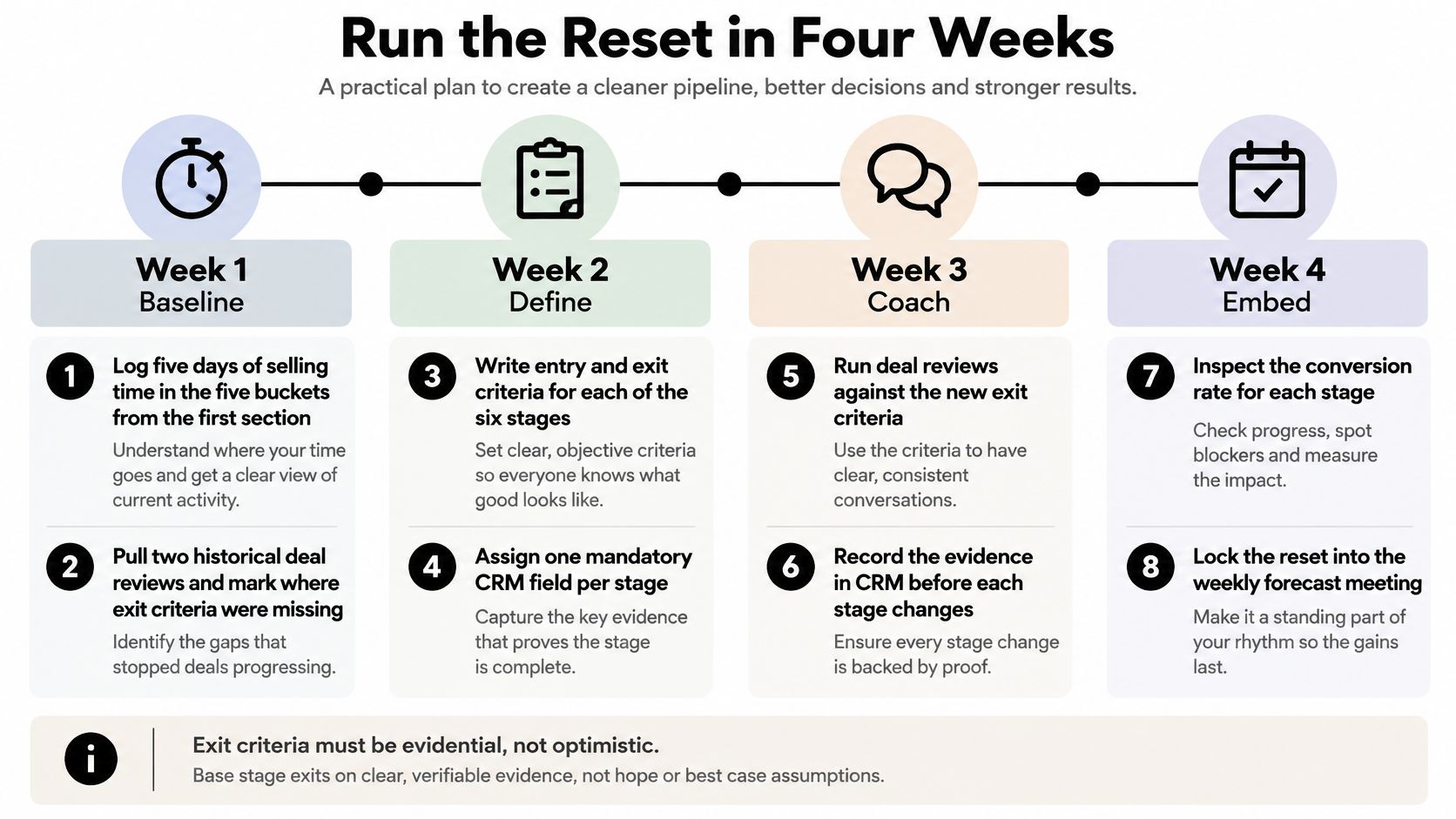
The point of a reset is reclaimed selling capacity and clean stage data, not more calls or stricter CRM policing. Automation counts only when a human approves the risky parts. Use the four-week sequence below to install the baseline, standards, and workflows in order, without asking the floor to absorb every change at once.
Weeks One and Two Baseline and Standards
Start by measuring reality and clearing dead wood before changing a single rule.
-
Week one, log five working days of selling time: Have every rep record their hours across the activity buckets, so you have a baseline before any changes land. The aim is to see where selling time leaks, not to shame anyone for admin.
-
Week one, pull two historical quarters of stage conversion: Export closed-won and closed-lost opportunities from the last six months and calculate conversion rates and cycle times stage by stage. The largest drop tells you where process discipline matters most.
-
Week one, purge the live pipeline: Mark genuine losses, merge duplicate accounts and contacts, and archive any opportunity showing zero prospect activity for 90 days. A dirty pipeline makes every later metric looks worse than it is.
-
Week two, lock the six stage definitions and mandatory fields: Publish the written entry and exit criteria, configure the single mandatory CRM field per stage, and train the floor in one thirty-minute working session. One field per stage is enough. More than that usually creates box-ticking.
-
Week two, pick three scorecard metrics with named owners: Put your top three priority metrics onto a shared Monday view and assign one person responsible for bringing the clean numbers each week. Without a named owner, the scorecard becomes decoration.
-
Week two, set an inbound response service level: Commit to acknowledging inbound enquiries within 15 minutes during UK business hours, completing initial qualification within two hours, and booking a live human touch the same working day. Speed only works if the next step is real.
Weeks Three and Four Automation and Review
Resist the temptation to automate everything at once. Shipping too many workflows in the same sprint triggers change fatigue and makes it impossible to tell which tweak helped. Start with workflows that remove admin while leaving judgement with the rep.
-
Week three, ship two workflows only: Switch on meeting-to-CRM capture and the stale-opportunity sweeper, keeping human approval enabled on both so reps build trust in the drafts and exception reports. If the output is noisy, fix the inputs before adding another workflow.
-
Week four, run the first focused loss review: Pull every deal that stalled or died at your single largest conversion drop, inspect the missing exit evidence, and agree one process tweak for the following week. Keep the review tight. A long list of fixes gives nobody a clear owner.
-
Week four, audit selling hours and decide keep, adjust, or kill: Compare week-four selling hours, CRM completeness, and revenue per selling hour against your week-one baseline. Keep workflows that clearly return time, tighten rules on noisy ones, and switch off anything reps work around.
Set a 90-day checkpoint on the calendar right after week four. Early novelty can lift compliance for a fortnight. What counts is whether reclaimed selling hours and clean stage data hold steady a full quarter later without constant chasing.
What to Fix When the Numbers Stall
Even a tidy reset hits friction after the first month. Reps slip back into familiar shortcuts when quarter-end pressure rises, and small process cracks widen fast. Rather than calling an all-hands pep talk, diagnose the exact stall using your stage data and assign one owner to fix the root cause.
Inflated pipeline usually appears first. The opportunity count climbs steadily while overall conversion drops, because qualification has reverted to accepting a polite verbal "yes, send us something" as a real deal. Strip verbal expressions of interest out of the qualified count immediately and enforce written evidence of problem, budget range, and timing before an opportunity enters the stage. The sales manager owns this audit every Monday before forecast review.
Follow-up decay hits right after proposals go out. Deals look healthy in discovery, PDFs get emailed, replies never arrive, and nobody logs a follow-up for two weeks. Pair your finite stopping sequence with a strict three-working-day rule that flags any open proposal lacking a recorded prospect touch. Each account executive owns timely execution, while the stale-opportunity sweeper audits overdue proposals automatically.
Discount creep shows up when average discounts widen across closed deals even though your win rate hasn't budged. In most small teams, reps concede price early because they skipped mapping the buyer's economic impact during discovery and have nothing else to negotiate with. Put explicit discount approval thresholds in place and require a short written value case at proposal stage before any commercial concession is even discussed. Sales leadership and finance own this boundary together, so pricing discipline doesn't depend on one manager's mood on the last day of the month.
Slow ramp drags down team output whenever you hire. If new reps take a couple of quarters to produce steady pipeline because onboarding stops at slide decks and product demos, replace passive reading with live operational reps. Build a curated folder of strong recorded discovery calls, pair every new hire with a structured two-week shadowing plan, and set a clear first-month qualified-pipeline milestone. The team lead owns that ramp cadence.
Stop Blaming the Floor for Upstream Bottlenecks
Managers instinctively blame sales reps when revenue flattens, yet stage conversion data often proves the bottleneck sits somewhere else entirely. If contact-to-qualified conversion collapses on paid campaign leads while referral leads convert smoothly, you have a marketing targeting problem, not a lazy sales floor. If deals cruise through discovery and proposal only to sit frozen in negotiation for weeks, check your internal turnaround times on custom pricing approvals and legal redlines.
Diagnostic check: Before coaching a rep on closing technique, pull the segmented stage conversion report to verify whether the drop belongs to one seller, one lead source, or one internal approval queue.
Using stage evidence to escalate upstream friction changes the tone of cross-functional meetings immediately. Finance, legal, and marketing respond far faster to a dated cycle-time chart showing deals stuck waiting for contract review than to vague complaints from sales about things moving slowly.
Choose One Metric and One Workflow to Start
Don't finish reading this and try to rebuild your entire commercial engine on Monday morning. Pick the single worst number on your scorecard right now, pair it with the one workflow that hits it directly, and run that pair alone for 14 days against your week-one baseline before touching anything else.
For most small UK teams, the choice comes down to one of two pairs:
- Low follow-up completion paired with the stopping follow-up sequence: Best if proposals routinely go cold after three working days with no logged next step.
- Poor CRM completeness paired with meeting-to-CRM capture: Best if reps hold good buyer conversations that never make it into clean fields before forecast day.
Define a clear pass before you begin. After a fortnight, selling hours need to be higher than baseline, your chosen metric must have moved firmly toward its healthy threshold, and the workflow must not have sent a single external message or altered a deal record without human approval. If the number hasn't moved, tune that single workflow once and rerun the test; don't bolt on a second automation to cover up a broken first one.
Where we fit at Zenfox.ai is straightforward. We connect Gmail, Slack, HubSpot, and Drive, build context around your live accounts and history, and let you spin up zero-code workflows from a plain-English description without waiting on a developer. Our AI Workers come from a catalogue of 28 templates across Sales, Marketing, Web, Support, Data, Finance, Admin, HR, Legal, and Operations, running continuously while pausing at decision points to ask for your input by default, with higher autonomy switchable later once trust is earned. The full onboarding flow takes about 10 minutes for a motivated user. Keep your standard honest regardless of what tools you run: the only proof that matters is selling hours climbing and follow-up completion holding above 90%, never how often the team logs in.
If you want to run that 14-day experiment without writing code or adding another bloated dashboard, Zenfox.ai connects straight into Gmail, HubSpot, Slack, and Drive to handle meeting-to-CRM capture, stale-deal exception reports, and structured follow-ups with human approval built in. Start with one workflow, keep full control over every risky commercial update, and measure the hours returned to your sales floor by visiting Zenfox.ai.