Target Account Selling: Your Actionable 2026 Playbook
Master target account selling with our actionable 2026 playbook. Learn to define, score, and engage high-value accounts with automation templates for Zenfox.ai.
Your team is busy all day. Reps are sending sequences, chasing demo requests, updating the CRM at night, and still ending the quarter with a pipeline that feels noisy rather than reliable. Most of the activity looks healthy on a dashboard. The outcomes don't.
That's usually the moment target account selling starts to make sense.
Instead of treating sales like a volume game, target account selling treats a shortlist of accounts as the market that matters. The shift is simple to describe and hard to operationalise. You stop asking, “How many leads did we touch?” and start asking, “Which accounts are worth coordinated effort, and how do we penetrate the whole buying group before momentum dies?”
Most guides stop at the theory. The practical problem is different. TAS only works if you can research accounts thoroughly, map stakeholders quickly, run coordinated outreach across channels, and keep sales, marketing, and leadership aligned without burying the team in admin. That's where process design and automation decide whether TAS becomes a repeatable system or an expensive side project.
Table of Contents
- Moving from Volume to Value with Target Account Selling
- Laying the Foundation Your Ideal Customer Profile and Account List
- Scoring and Prioritising Your Target Accounts
- Orchestrating the Multi-Channel Outreach Cadence
- Aligning Your Team and Defining Roles for Success
- Automating Your TAS Playbook with Zenfox.ai
- Measuring Success and Scaling Your Programme
Moving from Volume to Value with Target Account Selling
The old model still traps a lot of teams. Marketing hands over a large pile of leads. SDRs work fast. AEs cherry-pick what looks promising. Then everyone wonders why forecast quality is weak and why reps feel busy but not productive.
Target account selling fixes that by narrowing focus on purpose. Modern UK sales guidance frames TAS around a shortlist of roughly 50 to 200 strategic accounts, and reports that this focus can increase win rates by 20 to 40% because B2B deals usually involve 5 to 11 decision-makers who need coordinated engagement, not generic prospecting, according to monday CRM's target account selling guide.
That's the part many teams miss. TAS is not just “enterprise outbound with better personalisation”. It's an operating model built around named accounts, stakeholder coverage, timing, and disciplined resource allocation.
If you're already thinking about the overlap between TAS and account-based marketing, this guide on understanding ABM in 2026 is useful because it helps clarify where marketing creates account awareness and where sales turns that attention into deal movement.
Practical rule: If your reps can't name the accounts that matter most this quarter, you're not running target account selling. You're running hopeful prospecting with better tools.
What works is concentration. Fewer accounts. Better research. More stakeholders engaged earlier. Cleaner handoffs between SDR, AE, and marketing.
What doesn't work is pretending every inbound form fill deserves the same treatment as a strategic account. That approach burns the team twice. First in outreach effort, then again in forecast clean-up.
Laying the Foundation Your Ideal Customer Profile and Account List
A TAS programme usually fails before outreach starts. The failure happens when teams build a target list from opinions, old territory logic, or the loudest executive request. Good target account selling starts in the CRM, not in a brainstorm.
Start with closed won evidence
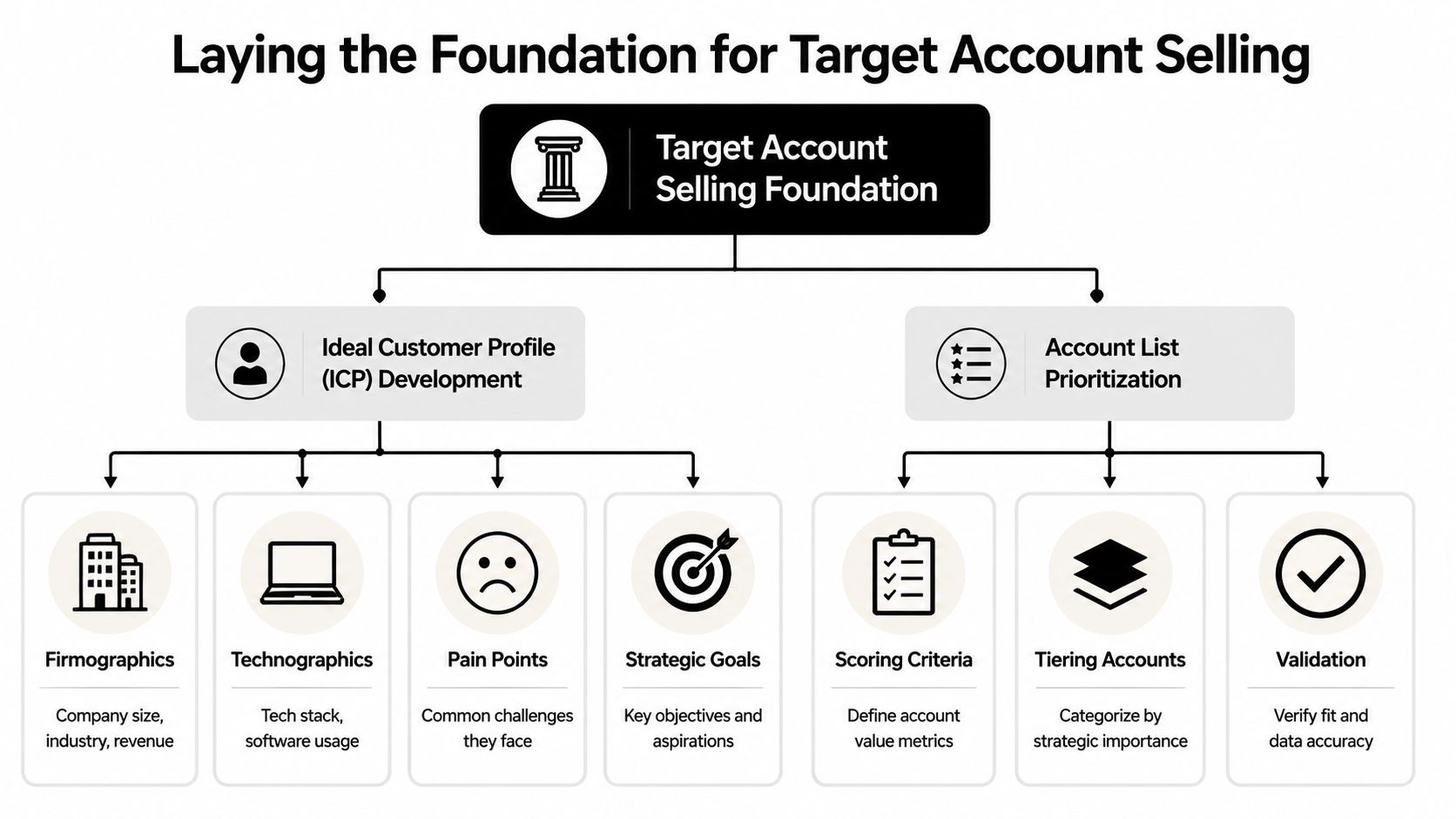
Pull your closed won accounts and look for patterns you can use. I'd break the review into four buckets:
- Firmographic fit such as industry, team size, geography, and sales complexity.
- Technographic fit such as the tools they already use, especially systems your product connects to or replaces.
- Pain pattern which is the recurring business problem that forced action.
- Buying behaviour including whether the account bought after a trigger event, internal change, or strategic initiative.
The goal isn't to produce a pretty ICP slide. The goal is to identify the conditions that show up repeatedly in accounts that buy, expand, and stay.
A disciplined process matters. One TAS benchmark says companies using an evidence-based approach to building their target account list captured 32% larger market share, achieved 22% higher engagement rates on personalised outreach, and improved pipeline forecasting accuracy by 25%, according to Martechdo's target account selling overview.
Turn the ICP into a living account list
Once the ICP is clear, build a Target Account List rather than a static spreadsheet. A useful list changes as accounts show more or less buying heat.
Signals worth watching include:
- Hiring shifts when an account starts recruiting roles tied to your problem space
- Growth events like expansion into a new market or a new product line
- Technology changes when they adopt, remove, or review relevant tools
- Competitive pressure when public messaging shows they need speed, efficiency, or differentiation
- Engagement clues from your own channels, such as repeat visits, email replies, or content consumption
Many teams blend lead generation and TAS poorly. They collect names before they've decided whether the account deserves strategic treatment. If that's happening in your pipeline, this piece on lead generation for SaaS is a useful companion because it helps separate broad demand capture from high-intent account selection.
The account list should be narrow enough to act on and dynamic enough to change weekly.
I'd also validate every account before it gets tiered. Check whether the problem is urgent, whether the account can support the likely deal size, and whether there's a realistic path to the buying committee. If the account fits the ICP but there's no sign of motion, it may belong in nurture rather than active pursuit.
A strong foundation feels almost boring. That's a good sign. When TAS is built properly, the flashy outreach work becomes much easier because the team is finally pointing at the right accounts.
Scoring and Prioritising Your Target Accounts
Once the list exists, the next problem appears fast. Every account looks promising to someone. Sales wants speed, marketing wants coverage, and leadership wants strategic logos. Without a scoring model, TAS turns into politics.
Use a simple score that sales can trust
The best scoring models are simple enough for reps to use and strict enough to stop random account chasing. I'd score accounts using four inputs.
| Scoring input | What to assess | What to look for |
|---|---|---|
| Firmographic fit | Does the account match your winning customer profile? | Industry, business model, company shape, market position |
| Technographic fit | Does their current stack support a realistic buying case? | Existing tools, integrations, replacement potential |
| Engagement level | Has anyone from the account shown interest in your company? | Replies, visits, content consumption, meeting acceptance |
| Intent signals | Is there evidence the account may need to act now? | Hiring, expansion, role changes, product launches, internal change |
You don't need a complex algorithm to start. What you need is consistency. If two AEs look at the same account, they should land in roughly the same place.
A practical rule is to score the account first, then score the buying environment. An account may fit perfectly on paper but still be a poor near-term TAS bet if there's no urgency, no visible change, and no likely internal sponsor.
Build three tiers with different effort levels
Tiering is where target account selling becomes manageable.
- Tier 1 accounts get deep research, multi-threaded outreach, custom messaging, and active AE ownership.
- Tier 2 accounts get solid personalisation and monitored engagement, but with tighter time limits on research.
- Tier 3 accounts stay in the system and get lighter-touch sequences, automation, and periodic review.
Don't tier accounts by logo vanity. Tier them by expected return on attention.
What works is matching effort to likely value. What doesn't work is giving every account a “strategic” label and then wondering why no one has time to do proper research.
I've seen teams improve focus immediately once they define a hard rule for each tier. For example, Tier 1 requires mapped stakeholders before sequence launch. Tier 2 requires a clear trigger event. Tier 3 can't consume manual AE time unless engagement changes.
That removes ambiguity. TAS scales when people know which accounts deserve human judgement and which ones should stay in a structured, lower-touch path until they earn more attention.
Orchestrating the Multi-Channel Outreach Cadence
A target account doesn't move because you sent a clever first email. It moves because the right people see a relevant message, across the right channels, close enough together that your team creates familiarity instead of noise.
The urgency matters. A 2026 analysis reported that opportunities closed within 50 days had a 47% win rate, while after that point win rate fell to 20% or lower, according to Prospeo's TAS guide. That's why slow, uncoordinated outreach underperforms. Good accounts still decay when nobody drives the process.
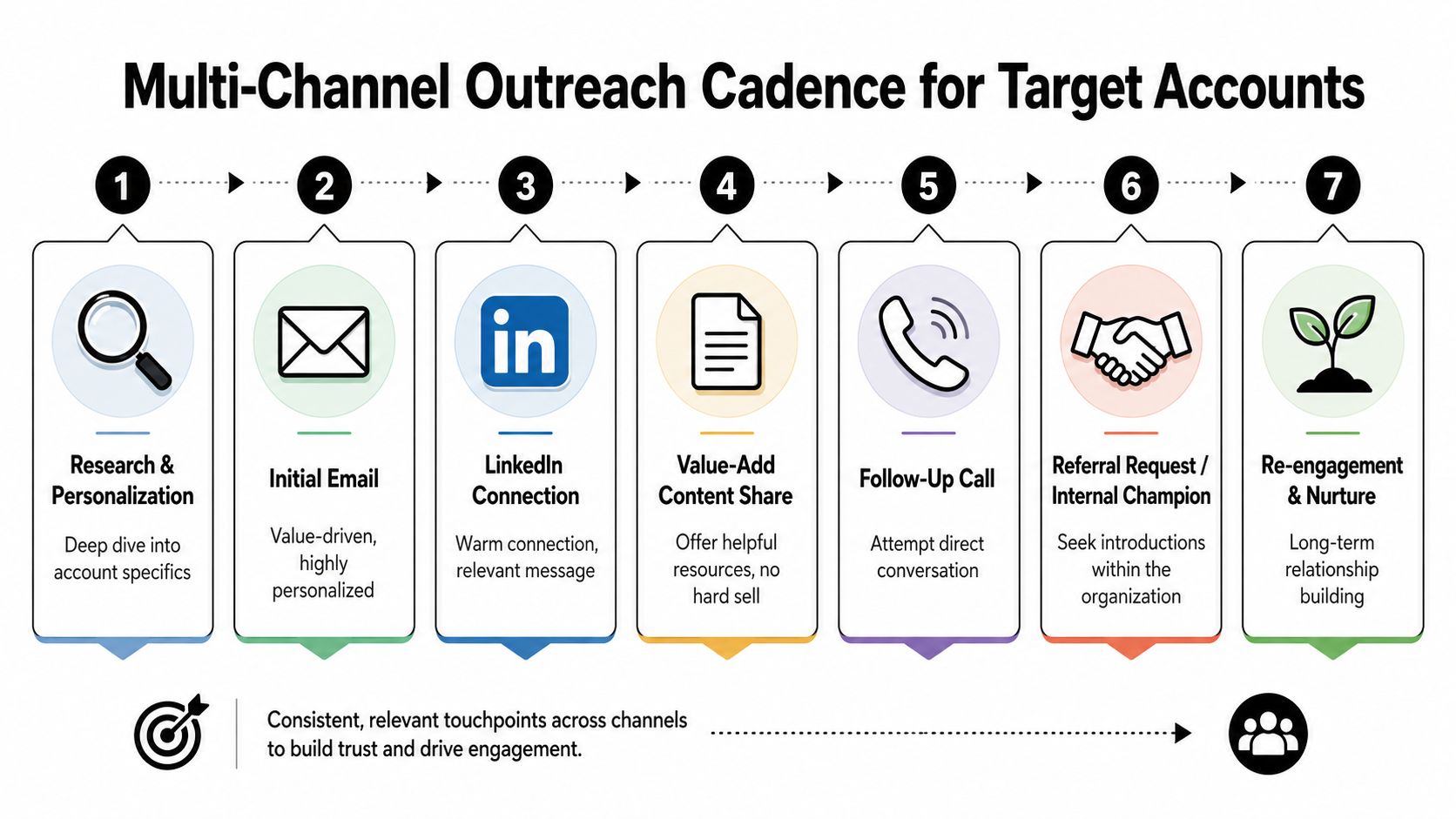
A useful visual for this is below.
What a real cadence looks like
For a Tier 1 account, I prefer a short, tight cadence that combines role-based messaging with multiple contact paths. The point is not to automate spam. The point is to create coordinated touches across the buying group.
| Day | Channel | Action | Target Persona |
|---|---|---|---|
| 1 | Personalised opener tied to current business context | Economic buyer | |
| 2 | Connection request with brief, relevant note | Champion or functional lead | |
| 3 | Follow-up with a sharper problem hypothesis | Department head | |
| 5 | Phone | Call main contact and one adjacent stakeholder | Budget owner and evaluator |
| 7 | Content share | Send relevant asset or point of view note | Influencer or user lead |
| 9 | Engage with recent company or contact activity | Secondary stakeholder | |
| 11 | Multi-threaded message referencing shared business issue | Buying group members | |
| 14 | Phone and email | Ask for routing, validation, or referral internally | Champion or coordinator |
That kind of structure works well whether you run the motions manually or through tools that automate sales outreach with these platforms. The platform matters less than the logic behind the sequence.
After the first wave, I like to review account response at the account level, not by individual email metrics. If one contact ignores you but another stakeholder engages, the account may still be warming.
A practical build for this sits well alongside a repeatable sales automation process, especially when SDRs and AEs are sharing ownership across the same named account.
Later in the motion, a short explainer or workflow walkthrough can help the team tighten execution.
How to personalise without slowing down
Most reps misunderstand personalisation. They think it means rewriting every sentence from scratch. It doesn't. In target account selling, personalisation means changing the parts that prove relevance.
Customise these first:
- The trigger that explains why you contacted the account now
- The business problem you believe they're facing
- The role angle for each stakeholder
- The proof point or example you choose to share
- The ask that fits their likely stage
What doesn't work is one generic sequence sent to procurement, operations, and the executive sponsor with the same message.
A good cadence feels coordinated from the buyer side. It should look like one company understands their account, not like three reps launched parallel templates.
Aligning Your Team and Defining Roles for Success
Target account selling breaks when ownership is fuzzy. Research gets duplicated. Marketing builds content no seller uses. SDRs book meetings with one contact while AEs assume the account is already mapped. Then the deal stalls because nobody found the actual approver.
That risk gets worse because TAS is resource-heavy. One common warning in TAS implementation is that deep research and multi-threaded engagement can create burnout, and the biggest failure mode is a weak stakeholder map that leaves unseen approvers out of the process, as noted in Streak's target account selling article.
Who owns what
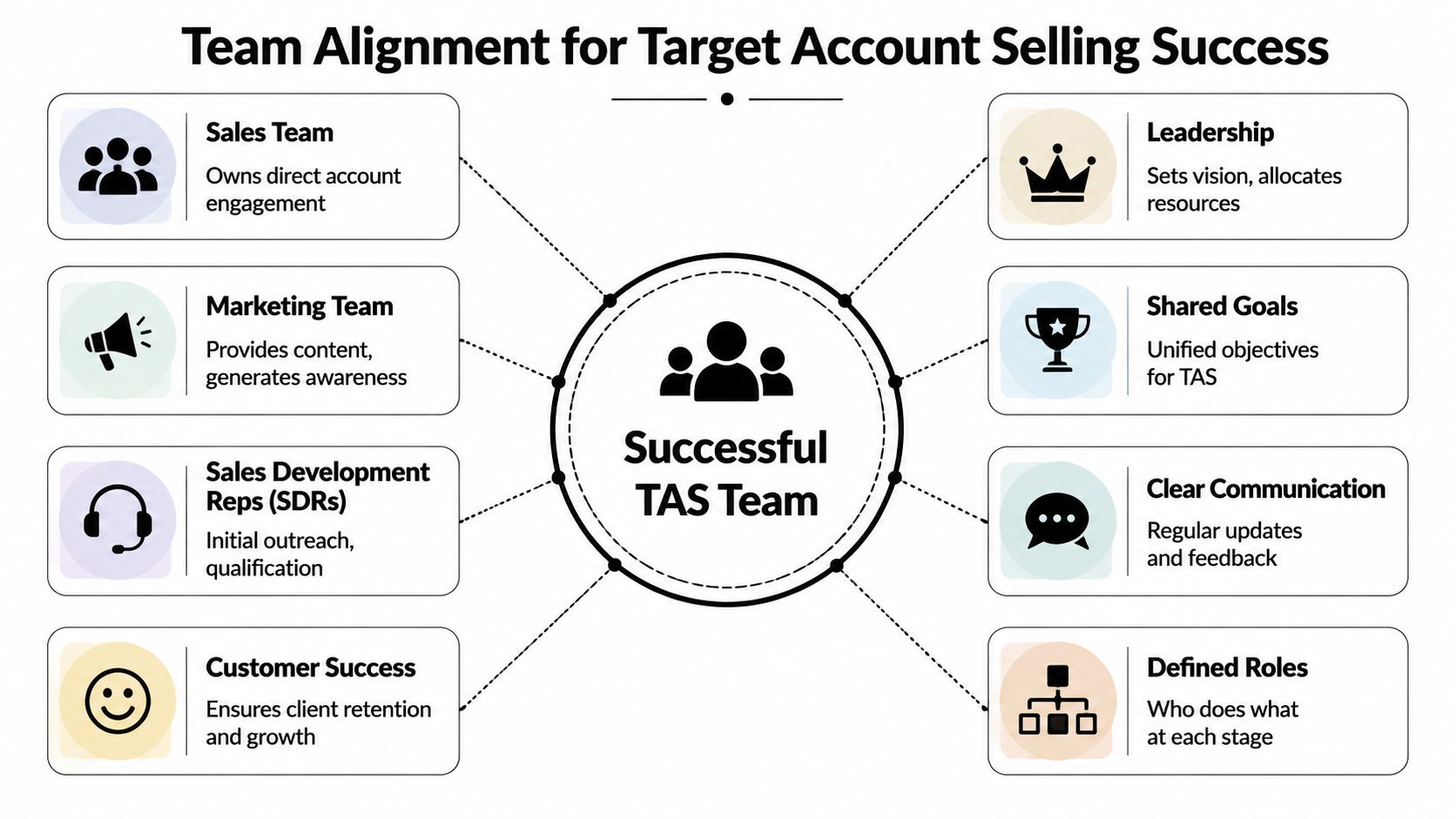
The cleanest TAS teams define role ownership early.
- SDRs open doors, validate hypotheses, and expand the stakeholder map. They should log blockers, champions, and referral paths, not just meetings.
- AEs own account strategy, value narrative, deal progression, and senior stakeholder engagement.
- Marketing supports named accounts with relevant content, air cover, retargeting, and insight on account engagement trends.
- Leadership helps when the account warrants executive access, pricing support, or strategic positioning.
- Customer success matters in expansion plays because they often know the internal politics better than sales does.
This shouldn't feel bureaucratic. It should remove duplicate work.
The SLA that keeps TAS from breaking
A working SLA in target account selling is not about lead acceptance speed. It's about shared account commitments.
Mine usually includes:
| Team | Commitment |
|---|---|
| SDR | Complete first-pass stakeholder map before escalation |
| AE | Approve account plan and outreach hypothesis |
| Marketing | Supply account-relevant content and campaign support |
| RevOps | Maintain scoring logic, routing, and reporting hygiene |
| Leadership | Join only when the account reaches agreed trigger points |
The important part is that everyone works from the same account view. If sales judges success by meetings and marketing judges success by form fills, TAS will drift back into a volume model.
The best TAS teams don't hand off leads. They coordinate around accounts.
That sounds obvious, but it changes how people behave. It also protects the team from burnout because effort is assigned deliberately instead of being pulled into every account that looks interesting for a week.
Automating Your TAS Playbook with Zenfox.ai
The biggest reason teams abandon target account selling isn't strategy. It's workload. Manual research, manual updates, manual follow-ups, manual meeting prep. A strong playbook turns brittle when it depends on rep discipline for every task.
That's why automation matters. Used properly, it doesn't remove judgement. It removes repetitive work so sellers can spend more time on account strategy, stakeholder conversations, and deal movement.
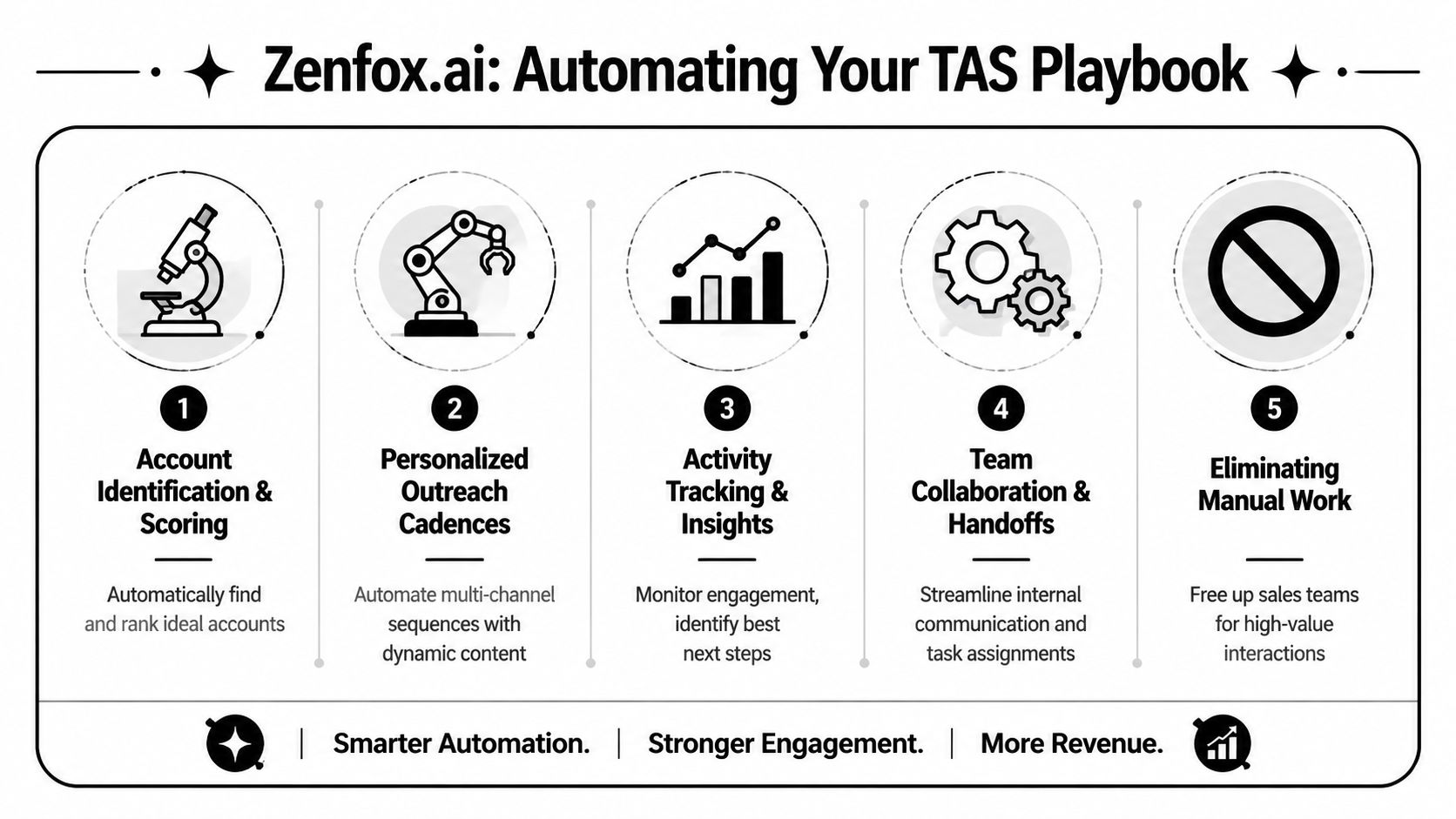
A practical way to implement this is with Zenfox.ai, which can connect tools like Gmail, Slack, HubSpot, and Drive, then execute workflows based on natural language instructions and account context. In a TAS environment, that's useful because the system can support account scoring, follow-up triggers, internal alerts, and meeting prep without forcing reps to click through five separate tools.
Workflow one live account scoring updates
Problem: account scores go stale fast.
If a target account adds a relevant job opening, appears in a monitored news topic, or shows a new engagement signal, someone needs to update the account record. Often, that “someone” is nobody until the weekly pipeline review.
Recipe:
- Monitor target accounts for defined intent signals.
- Match the signal to the account record in HubSpot.
- Adjust the account score or tier based on pre-set rules.
- Notify the account owner when the change crosses a threshold.
This keeps the TAL alive. Reps stop working last month's assumptions.
Workflow two follow up based on real engagement
Problem: good engagement often dies in an inbox.
A contact from a strategic account opens, replies, or clicks, but the next action depends on the rep noticing it in time. That's risky in TAS because timing matters.
Recipe:
- Watch for engagement from contacts tied to Tier 1 accounts.
- Trigger a follow-up draft in Gmail with the right account context.
- Assign the AE a task if the contact is senior or if multiple stakeholders engage.
- Log the activity back to the CRM automatically.
Automation provides assistance without sounding robotic. The system handles timing and context. The AE still decides how to shape the conversation.
Workflow three buying signal alerts for the whole team
Problem: account intelligence sits with one person.
If web activity spikes, a competitor gets mentioned, or several contacts from the same account engage within a short period, the signal should not live only in a browser tab.
Recipe:
- Monitor account-level activity and grouped engagement.
- Post an alert into a shared Slack channel for named accounts.
- Include the account owner, the recent signals, and the recommended next action.
- Create a follow-up task if the alert matches a Tier 1 or active opportunity rule.
That changes team behaviour quickly. SDRs, AEs, and managers see the same signal at the same time.
Workflow four automated pre call briefs
Problem: reps go into important calls underprepared because briefing takes too long.
For a serious target account meeting, sellers need a compact view of CRM history, recent account news, role context for attendees, and open questions. That's valuable work, but it's repetitive.
Recipe:
- Pull meeting attendees from the calendar event.
- Gather CRM notes, prior emails, and relevant documents.
- Add recent company updates and stakeholder context.
- Generate a briefing doc in Google Docs before the meeting.
- Share it with the AE and anyone joining the call.
Automation should handle the repeatable mechanics. Sellers should handle judgement, positioning, and trust.
That's the cheat in scalable target account selling. Don't automate the buyer relationship. Automate the admin that keeps your team from building one.
Measuring Success and Scaling Your Programme
Most sales dashboards still overvalue activity. TAS needs different measures. If you judge target account selling by raw lead count, you'll shut it down too early or scale it in the wrong direction.
Track account outcomes not vanity metrics
Look at metrics that reflect account movement and buying group penetration.
- Account engagement quality rather than isolated opens or clicks
- Stakeholder coverage across economic buyer, evaluator, user, and blocker roles
- Pipeline velocity for named accounts
- Revenue per account and average deal quality
- Win rate on target accounts
- Forecast confidence based on real account evidence
These metrics force better behaviour. Reps stop celebrating shallow activity. Managers stop confusing motion with progress.
Use a hybrid model when TAS is too heavy
A mistake I see often is trying to run full TAS on every account. That's rarely sensible, especially in the UK where many businesses sit in the SME segment. A more practical question is which accounts deserve human-led TAS and which should move through an AI-assisted, lower-touch motion. That trade-off is discussed directly in Highspot's take on target account selling.
A common answer is a hybrid model. Reserve full account orchestration for the accounts where deal size, complexity, and strategic value justify the effort. Use automation, lighter qualification, and structured nurture for the long tail.
That gives you scale without losing focus. It also makes the programme easier to defend internally because senior sales time is being spent where it matters most.
If you want to turn target account selling into a repeatable operating system rather than a one-off initiative, take a look at Zenfox.ai. It can help automate the research, alerts, follow-ups, and CRM work that usually slow TAS down, while keeping human effort focused on the accounts that deserve it.