
Competitive Intelligence Tools: 10 Picks Compared
Compare 10 competitive intelligence tools, with strengths, limitations, pricing snapshots and a framework to pick the right fit for your team.

No single competitive intelligence tool does everything well, and smaller businesses can't afford to confuse collecting information with becoming more competitive. In its 2022 State of UK Competition report, the Competition and Markets Authority found that 57% of businesses with fewer than 250 employees believed competing with larger companies had become harder than it was five years earlier. Buying the broadest dashboard isn't necessarily the answer.
Teams often juggle distinct intelligence jobs: monitoring changes, arming sales, benchmarking digital presence, and researching search competition. Page watching and company discovery support those jobs, but they don't replace them. A pricing-page alert tells you something changed. It doesn't tell a seller how to respond to a buyer's objection.
The tools below serve different purposes. Zenfox's Competitive Intelligence and Contify support ongoing monitoring; Crayon and Klue concentrate on sales enablement; Similarweb benchmarks digital reach; Semrush, Ahrefs and SpyFu investigate search competition. Visualping watches specific pages, while Owler helps you discover and follow companies.
Choose by the decision you need to make, not the longest feature list. Name the question, identify the evidence needed, and decide who will act on the answer. Then test the tool against that workflow. A freelancer checking rival service pages needs something different from a product-marketing team maintaining competitive guidance for sellers.
Table of Contents
- 1. Competitive Intelligence for Automated Competitor Monitoring
- 2. Crayon
- 3. Klue
- 4. Contify
- 5. Similarweb Web Intelligence
- 6. Semrush
- 7. Ahrefs
- 8. Visualping
- 9. SpyFu
- 10. Owler
- Competitive intelligence tools at a glance
- How to Choose a Practical Decision Framework
1. Competitive Intelligence for Automated Competitor Monitoring
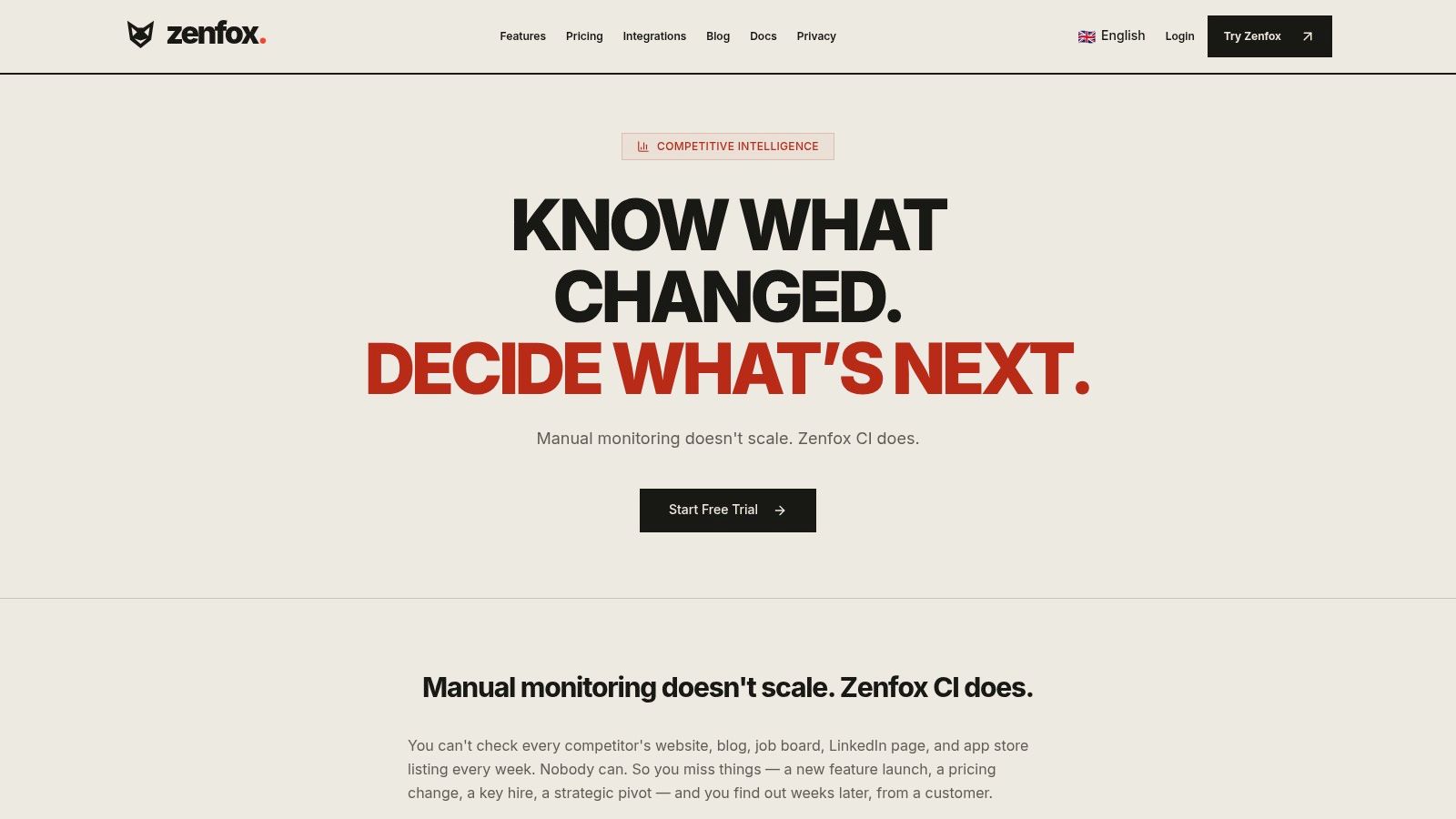
Best for small teams that want recurring competitor briefings rather than another research routine. Zenfox Competitive Intelligence watches a competitor's blog, careers page, social accounts and GitHub. Add a rival by name or URL and Intel discovers those sources automatically, so monitoring starts without a manual inventory of where the company publishes.
Weekly briefings give you a fixed review point. Because Intel sits inside a wider automation platform, a finding can feed connected workflows rather than sitting unread in a feed.
A Workflow That Separates Evidence From Interpretation
Say a competing software company publishes a run of technical blog posts, pushes new repositories to GitHub and advertises implementation roles on its careers page. Review those signals together, open the original sources, then record a hypothesis: the company may be investing in more complex deployments. Keep that hypothesis labelled as a hypothesis until stronger evidence turns it into a confirmed strategy.
- Strength: Four source types discovered from a single name or URL removes the routine of checking disconnected sites by hand.
- Trade-off: Weekly briefings aren't a substitute for immediate alerts when a development requires urgent action.
- Evaluation point: Test coverage depth, competitor limits and monitoring controls against your actual rival list.
Practical rule: Keep the observed change, your interpretation and the recommended action separate.
That distinction matters with any AI-enabled monitor. In UK government AI adoption research, 56% of AI adopters reported concerns about bias and lack of accuracy. Zenfox's own AI-generated outputs can contain inaccuracies and are not fact-checked, so verify anything material before relying on it for professional decisions.
A polished briefing is easy to produce. What matters is whether you can inspect the evidence behind it, identify uncertainty and decide what deserves follow-up.
2. Crayon
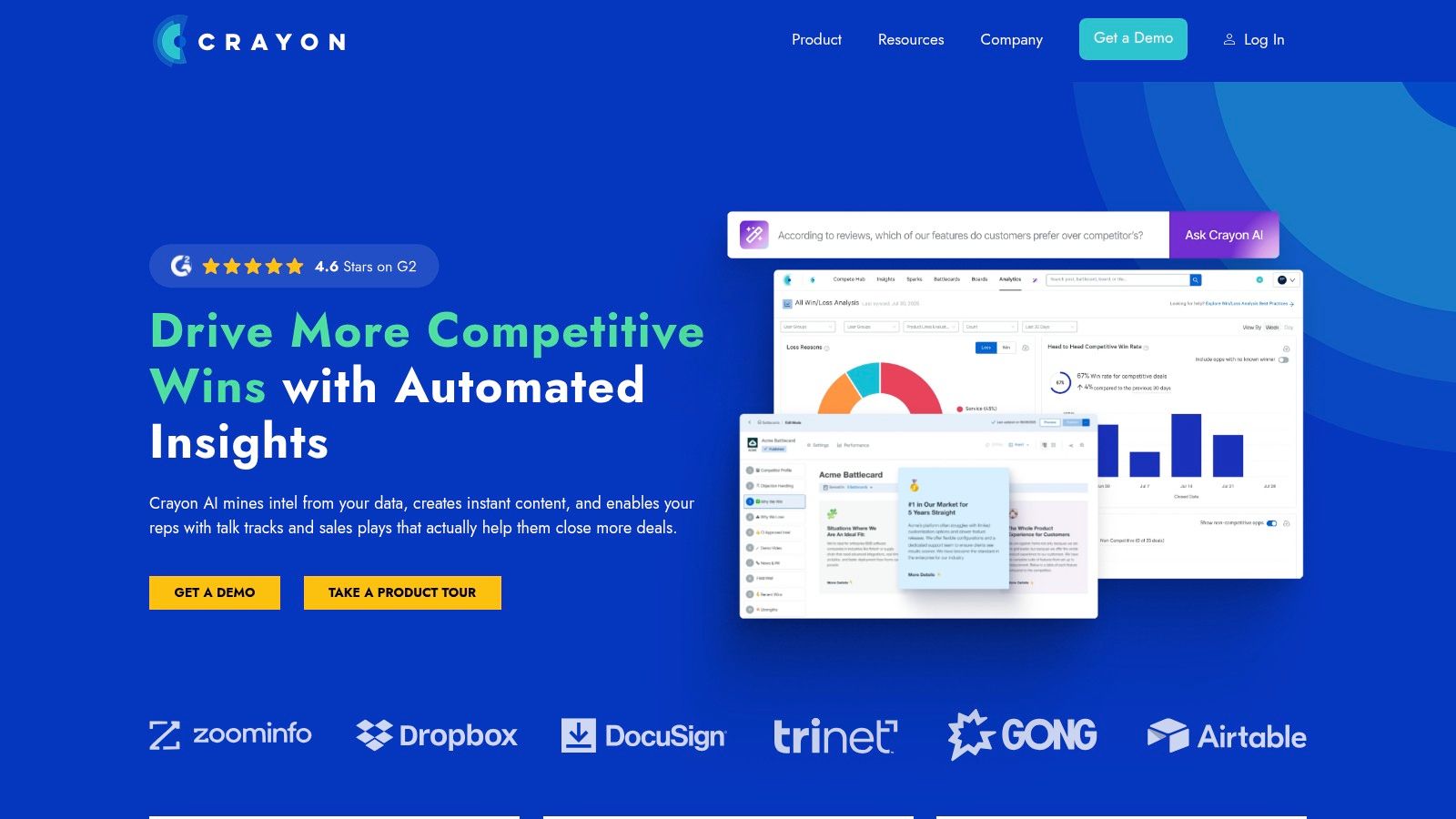
Choose Crayon when competitor information needs to become sales guidance. Crayon combines external signals, including website changes, news, social activity and reviews, with internal intelligence from sources such as call recordings and collaboration tools. Its practical outputs include battlecards, briefings and win stories.
The important distinction is distribution. Collecting a competitor announcement is useful, but a seller needs the relevant implication inside an existing sales workflow, not buried in a research feed.
Turn an Update Into a Usable Response
Suppose a rival announces a new reporting feature. A product marketer checks the announcement, compares the documented capability with your product, and updates the relevant competitive guidance. Sellers then get a qualification question and an evidence-backed response rather than a vague claim that your product is better.
Use a consistent structure for sales battlecards: buyer context, verified differences, discovery questions and claims to avoid. Assign an owner to keep that guidance current.
- Works well: Monitoring and sales-enablement materials sit within the same programme.
- Needs work: Someone must curate findings and remove stale or unhelpful content.
- Commercial trade-off: Custom pricing makes early budget comparison less straightforward than a self-serve subscription.
Crayon makes more sense when competitive deals recur and someone owns enablement. For a solo consultant who only needs occasional competitor checks, maintaining the programme may demand more effort than the output justifies.
3. Klue
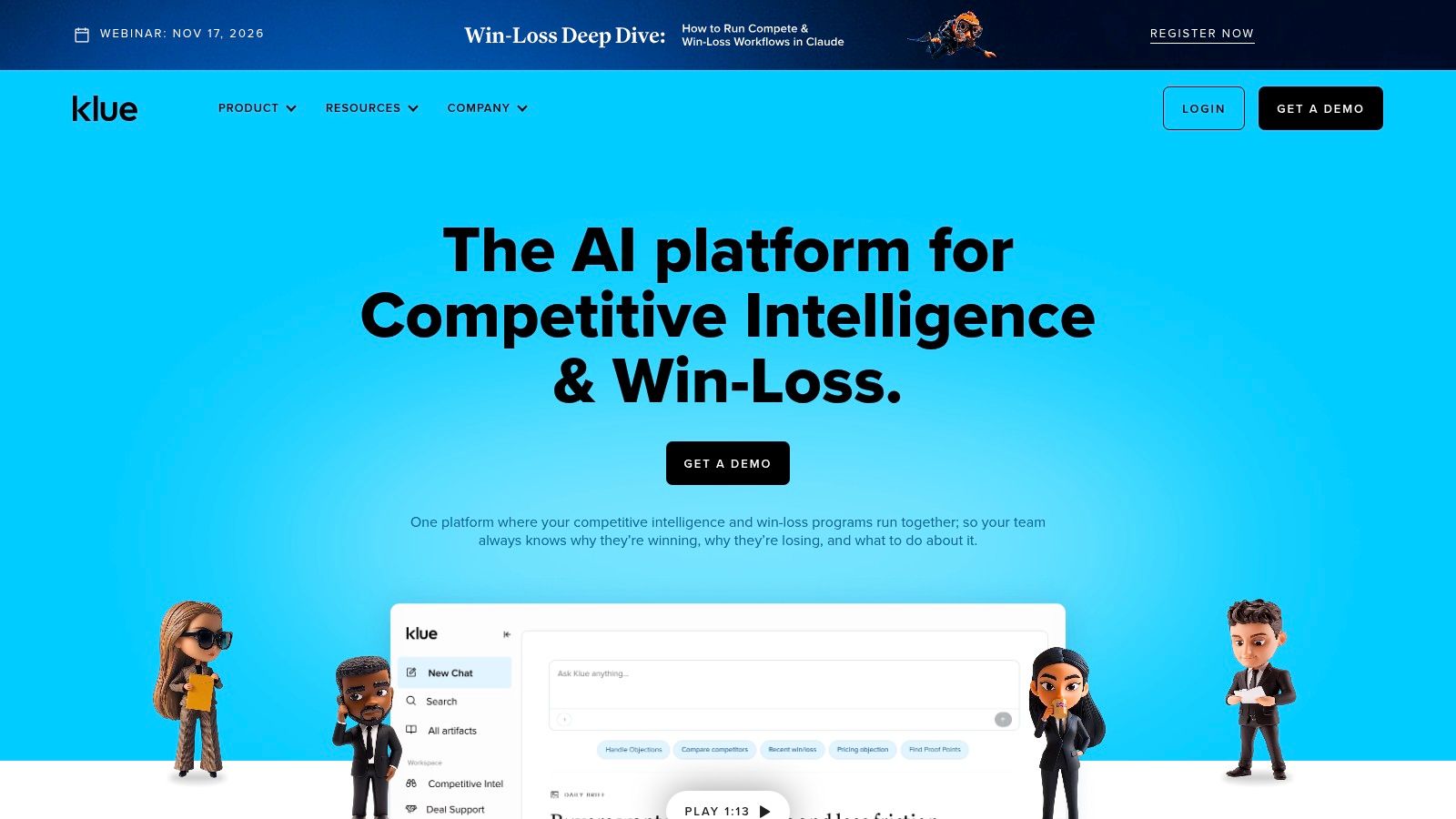
A seller asks why a prospect prefers a rival. That's a different problem from tracking what the rival published. Klue connects competitor research, deal support and win/loss analysis, making it particularly relevant to B2B revenue and product-marketing teams.
Its Compete Agent supports competitor research and sales questions, while its win/loss capabilities help teams examine patterns in buyer feedback. The useful combination is external evidence about competitors alongside internal evidence about purchasing decisions.
Start With the Buyer's Objection
Say a prospect describes a competitor as easier to implement. Check what that means before answering: fewer configuration steps, better onboarding, stronger documentation, or a more convincing demonstration. Use competitive research to establish product differences, then compare those findings with buyer feedback from completed deals.
A competitor's positioning explains what it wants buyers to believe. Win/loss work helps you understand what buyers actually believed.
Klue's strength is connecting those perspectives. It's a stronger fit when sellers repeatedly need deal-specific answers than when an individual researcher wants general company news.
The weakness is scope and ownership. Quote-based pricing makes initial budgeting harder, and the platform still needs people to review evidence and maintain useful competitive content. Broader industry scanning or detailed digital-traffic analysis may call for a separate specialist.
When evaluating it, bring genuine objections and anonymised deal questions. A generic product demonstration won't reveal whether the answers are specific enough for your sales conversations.
4. Contify
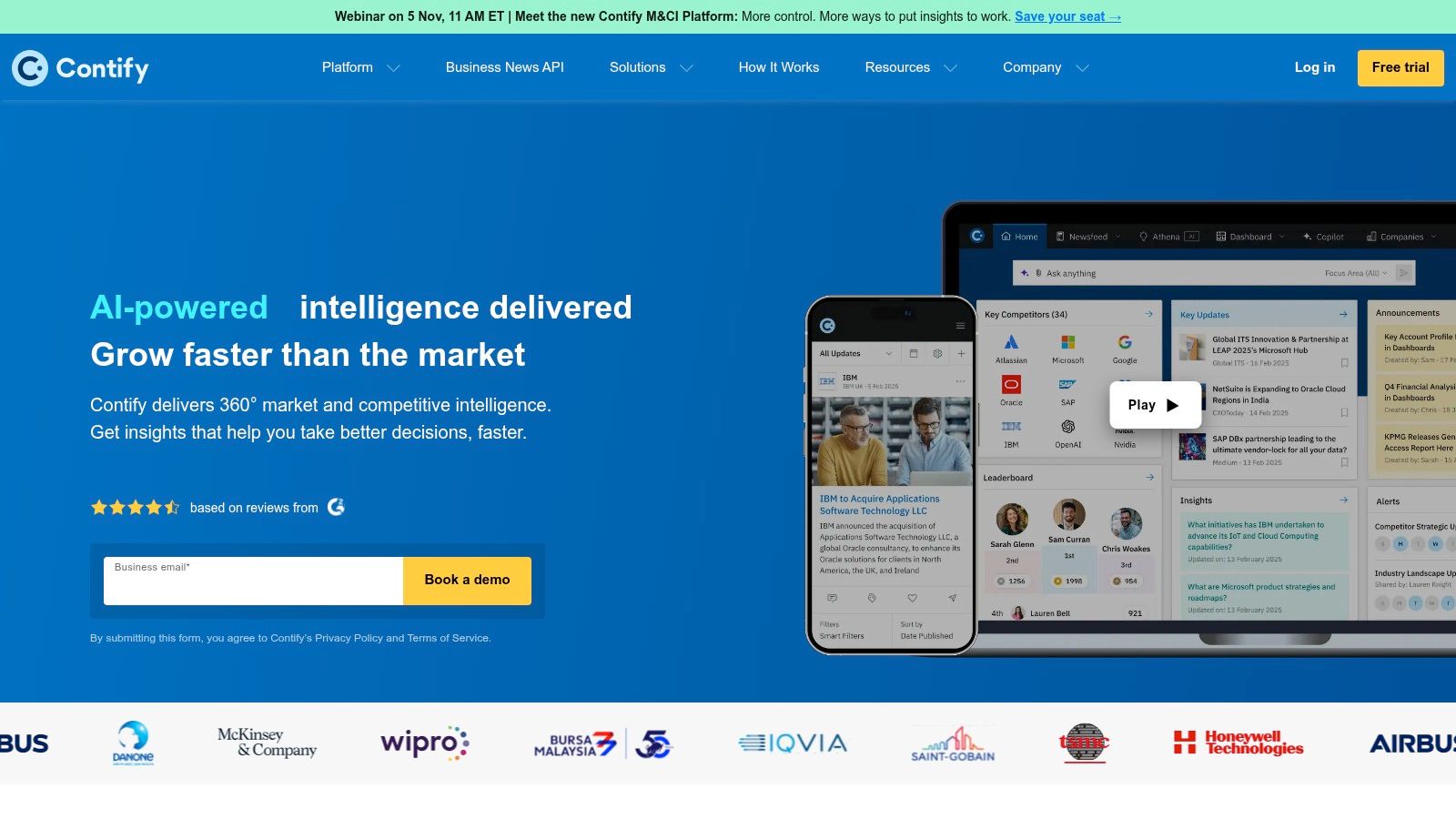
Contify suits monitoring programmes that extend beyond named competitors. Contify covers competitors, industries, markets and key accounts through customized feeds, structured intelligence, website-change monitoring, AI summaries and newsletters.
That broader scope matters when your question concerns a market shift rather than a single company. A startup selling to retailers might need to follow rival launches, customer expansion plans and changes affecting the sector.
- Strongest use: Building a shared market-intelligence feed for different stakeholders.
- Main trade-off: Relevant feeds require deliberate sourcing, tagging and filtering.
- Buying consideration: Custom pricing is harder to compare with lightweight page-monitoring subscriptions.
Organise Around Questions, Not Mentions
Start with an intelligence question such as which competitors are expanding into your target segment. Define useful signals: relevant product launches, customer announcements, partnerships and hiring activity. Separate those from generic brand mentions before distributing a newsletter.
A narrowly defined taxonomy helps readers distinguish a meaningful expansion signal from an unrelated announcement. Give each briefing an editorial owner who can explain why an item matters.
For a simpler recurring subject digest, our Topic Monitor suggests keywords, selects sources and delivers relevant updates. That's a different starting point from building a broader structured market-intelligence programme.
Contify's weakness for an individual user is the work needed to shape that programme. If you're only watching a competitor's pricing and feature pages, a focused page watcher may answer the question with less setup.
5. Similarweb Web Intelligence
Similarweb answers where competitors appear to attract attention, not why customers choose them. Similarweb Web Intelligence benchmarks website traffic, engagement and acquisition channels, and can help identify competitors beyond your existing list.
Its figures are estimates, not access to competitors' first-party analytics. Treat them as directional evidence for investigation rather than audited commercial results.
Compare Like With Like
Suppose you're deciding whether to develop referral partnerships or invest more in organic content. Compare relevant competitor domains using the same geography, period and channel definitions. Inspect notable referral sources and search activity before proposing an experiment.
- Useful output: A defensible hypothesis about channel mix and digital reach.
- Weak output: A claim that a competitor's estimated visits prove its revenue or customer growth.
- Important boundary: A domain may contain support documentation, recruitment pages or international activity that doesn't match your target market.
Similarweb is particularly helpful for marketers comparing digital acquisition strategies. It can also reveal that your search competitors differ from the companies your sales team encounters.
The limitation is interpretation. A traffic increase could warrant investigation, but it doesn't explain profitability, lead quality or customer satisfaction. You'll still need qualitative customer and sales intelligence.
Choose it over a general monitoring platform when the decision concerns digital reach and channel allocation. Choose a monitor when the priority is detecting launches, messaging changes or other company developments.
6. Semrush
A keyword-gap report can generate plenty of work without identifying anything worth publishing. Semrush is useful when you can turn search observations into selective marketing decisions. Semrush combines competitor keyword, ranking, backlink and advertising research with wider SEO capabilities.
Its breadth suits marketers handling several related tasks. Depending on the toolkit and plan, that work can extend to paid-search research and AI search visibility.
Build a Brief, Not an Export
Start with a rival that appears for searches your buyers use. Separate branded queries from non-branded topics, then group relevant gaps by intent: learning, comparing suppliers or preparing to purchase. Inspect the ranking pages before deciding whether to create something new or improve an existing page.
- Advantage: Search research and implementation tools are available within a broad marketing suite.
- Friction: Toolkits, usage limits and add-ons can complicate both navigation and cost.
- Boundary: Search visibility won't explain a buyer's procurement requirements or a competitor's implementation quality.
The wrong approach is copying every topic a rival ranks for. A competitor may target an audience you don't serve, maintain legacy content or pursue traffic that has little commercial value for your business.
Semrush offers a free tier alongside paid plans, which helps with an initial fit check. Test the specific reports your workflow requires rather than judging the platform by its feature count. It's a strong category fit when your main intelligence question concerns how competitors acquire search visibility.
7. Ahrefs
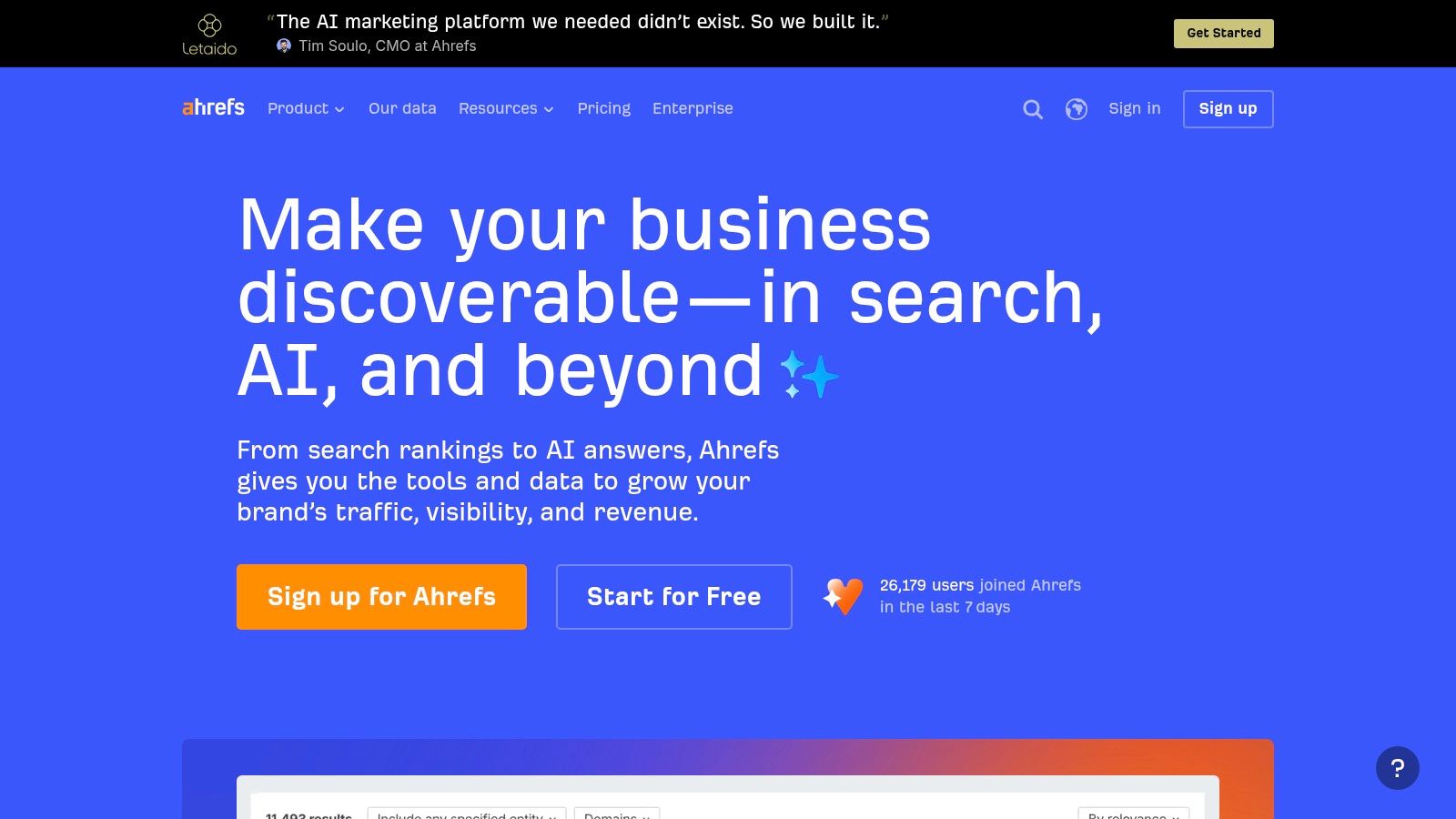
Pick Ahrefs for focused organic-search and backlink investigation. Ahrefs provides competitor page, keyword and backlink research through tools including Site Explorer and Keywords Explorer, alongside Rank Tracker and Site Audit for ongoing SEO work.
Compared with a broad competitive-intelligence platform, its role is narrower. It helps you investigate how websites earn search visibility, not maintain a complete account of company strategy.
Trace the Page Behind the Ranking
Take a competitor page that ranks for a relevant commercial query. Examine its topic coverage, search intent and referring domains, then compare it with your own equivalent page. Decide whether your gap concerns content quality, a missing resource, technical accessibility or relevant links.
Don't copy a competitor's backlink list indiscriminately. Inspect the linking page and establish why your own resource would deserve a reference.
- Strength: A clear fit for keyword, content and backlink research.
- Limitation: It doesn't replace company-news monitoring, battlecards or buyer interviews.
- Access consideration: A limited free account serves owners of verified websites, but that isn't equivalent to unrestricted competitor research.
Ahrefs works well when someone will act on the findings through content improvement, technical fixes or targeted outreach. It's less compelling for an occasional researcher who won't use those implementation tools.
During evaluation, investigate familiar domains and inspect the underlying pages. A useful report should help you choose an action, not merely provide another authority score to include in a presentation.
8. Visualping
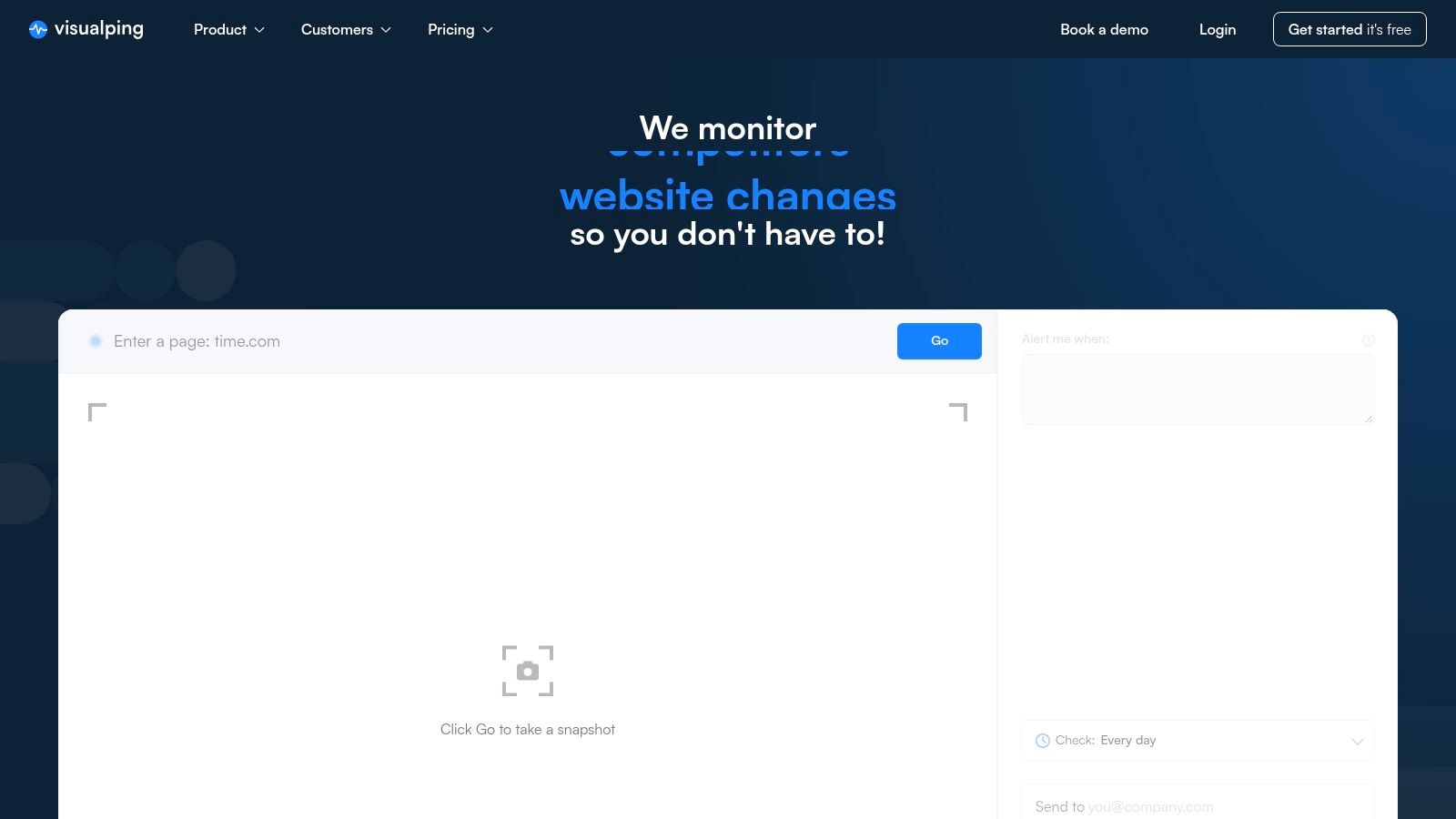
Sometimes the intelligence question is whether a particular page changed. Visualping monitors selected webpages for visual, text and element changes, making it useful for competitor pricing, product, careers and messaging pages.
Its narrowness is an advantage when you know exactly what matters. You don't need a broad market-intelligence programme to notice that a rival has rewritten a plan description.
Watch the Relevant Part of the Page
Select the pricing section or feature comparison rather than the entire page wherever practical. Otherwise, rotating banners, navigation updates and unrelated content can distract from the change you care about.
Build a review workflow around the alert. Preserve the change, inspect the live page, classify its significance and assign follow-up only if it affects a real decision. Our guide to creating a simple automation explains the broader approach to turning recurring triggers into actions.
- Works well: Targeted monitoring without repeatedly opening the same public pages.
- Requires care: Monitoring allowances and check frequency must match the importance of each page.
- Doesn't replace: Strategic interpretation, competitive positioning or win/loss analysis.
Visualping includes AI change summaries and importance indicators, with delivery options depending on the plan. Those features can help triage alerts, but verify the underlying edit before circulating a conclusion.
It's a practical complement to a specialist search or sales tool. It's less suitable as the sole system when you also need source discovery and a consolidated view of company activity.
9. SpyFu
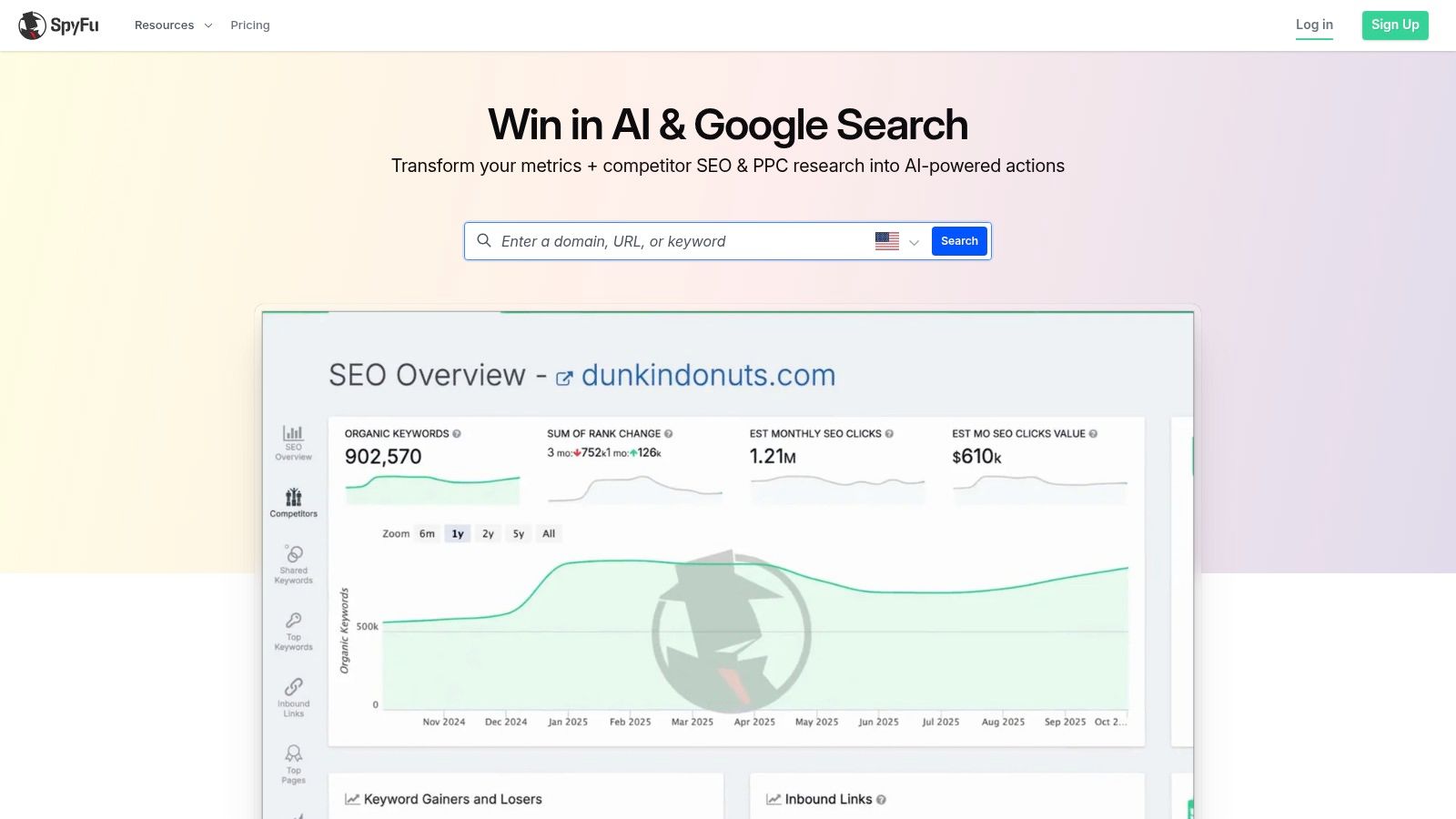
Historical advertising context is SpyFu's useful distinction. SpyFu focuses on competitor SEO and paid-search research, including keyword overlap, rankings and Google Ads history.
For a marketer examining search campaigns, historical records can provide more context than a current advertisement alone. They're a starting point for understanding how a rival's search messaging has changed, not proof that its campaigns were profitable.
Use Advertising History to Form a Test
Suppose you're preparing a campaign for a specialist accounting service. Investigate relevant competitor domains, inspect available keyword and advertisement history, and identify repeated themes worth testing. Compare those themes with your own customer language before writing advertisements or changing landing pages.
- Good fit: Investigating search overlap and historical advertising messages.
- Coverage caution: Check relevance against your UK niche, target keywords and known competitors.
- Poor fit: Monitoring product releases, hiring activity or objections in live sales deals.
Persistent advertising can justify closer inspection, but don't assume a rival has measured its economics correctly. Your own conversion quality and acquisition costs must determine whether a campaign continues.
SpyFu is more focused than a broad marketing suite. That can be helpful if your recurring questions concern Google search competition and you don't need a wider set of marketing tools.
Evaluate it with familiar queries before committing. If the relevant domains and terms aren't represented well enough, an attractive interface won't make the resulting decisions more reliable.
10. Owler
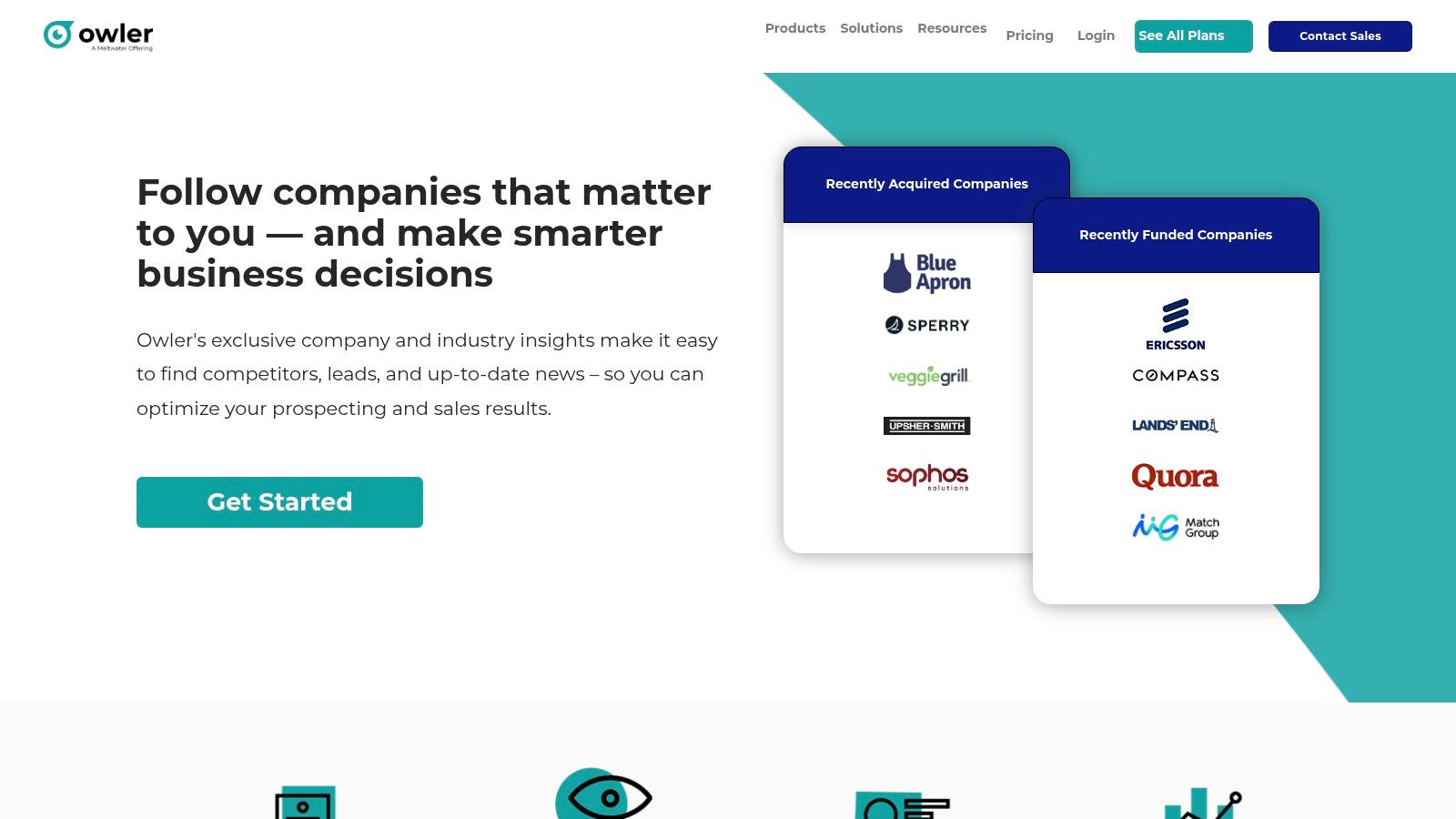
Your competitor list can be wrong before monitoring starts. Owler supports company discovery through company profiles, a competitor graph and company-news updates.
Use it to investigate who belongs on the list, particularly when you're entering an unfamiliar segment. Its role differs from tools that analyse keywords or watch selected webpages.
Validate the Rival List Before Tracking It
Start with a known supplier, explore related companies, then verify each candidate against its own website. Separate direct alternatives from adjacent providers, potential partners and businesses that merely share a broad category.
News snapshots can then help you follow developments across the relevant set. Keep a short rationale for including each company so your monitoring programme doesn't expand because more profiles are available.
- Advantage: Company discovery and lightweight news following work together.
- Access trade-off: The free Community tier has restricted following and profile access.
- Functional limit: Owler isn't a deep SEO, traffic-benchmarking or battlecard platform.
A company profile is a discovery aid, not a substitute for checking material claims. Confirm important developments with primary announcements or other appropriate evidence before changing your strategy.
Owler fits early market mapping and ongoing company awareness. If you already know your rivals and need to detect precise pricing-page edits, Visualping is the more directly matched category. If you need to understand organic search competition, use a search-research specialist instead.
Competitive intelligence tools at a glance
The useful split is the intelligence job, not the feature list. Treat the pricing column as a buying signal: quote-led tools tend to package services and seats, while self-serve tools are easier to trial before procurement.
| Primary job | Pricing snapshot | Free option | Best for |
|---|---|---|---|
| Zenfox, automated competitor monitoring across multiple sources | Free, Pro, Max and Enterprise plans; 7-day Pro trial for eligible new accounts | Free plan; eligible new accounts get a 7-day Pro trial | Teams that want competitors' blogs, careers pages, social accounts and GitHub activity gathered automatically |
| Crayon, competitive intelligence and sales enablement | Custom pricing; request an estimate | No free plan listed | B2B teams creating battlecards and sales insights |
| Klue, competitor research, win/loss analysis, and deal support | Quote-based; demo-led | No free plan listed | B2B revenue and product-marketing teams |
| Contify, market, competitor, and account intelligence | Custom pricing | 7-day free trial | Teams sharing structured intelligence across stakeholders |
| Similarweb Web Intelligence, website traffic and audience benchmarking | Check vendor pricing page | No free plan listed | Marketers comparing competitors' digital reach and traffic sources |
| Semrush, SEO, paid-search, and digital-marketing research | Self-serve subscriptions; check current plan page | Free tier available | Marketers and businesses researching search competitors |
| Ahrefs, SEO, backlink, and keyword research | Self-serve subscriptions; check current plan page | Limited free account for verified website owners | SEO teams analysing competitor search performance |
| Visualping, webpage change monitoring | Self-serve subscriptions; check current plan page | Free monitoring allowance | Users tracking changes to selected competitor pages |
| SpyFu, competitor SEO and paid-search research | Public plans; entry price shown in purchase flow | Check vendor pricing page | Marketers examining competitor keywords and ad history |
| Owler, company research, competitor discovery, and news | Pro and Enterprise tiers; Enterprise pricing on request | Free Community tier with limited access | Users discovering competitors and following company news |
Pick the row that matches the decision you need to make this quarter, then confirm current packaging before rollout.
How to Choose a Practical Decision Framework
Start with the intelligence job that matters most this quarter. Monitoring, sales enablement, traffic benchmarking and search research require different evidence and different outputs. Don't buy a platform to solve a problem your team hasn't defined.
Identify the Decision and Its Owner
Write a concrete question: which rivals changed their offer, why buyers prefer an alternative, where competitors attract visitors, or which search topics deserve investment. Name the person who will review the evidence and decide what happens next.
Measure usefulness rather than activity. The UK government's AI Adoption Survey framework distinguishes adoption, barriers and business impact, a useful approach for evaluating AI-enabled intelligence tools. Track validated insights, review effort and completed follow-up actions rather than treating logins as success.
Match the Question to the Category
Use automated monitoring for recurring developments, Crayon or Klue for sales guidance, Similarweb for traffic benchmarking, and Semrush, Ahrefs or SpyFu for search research. Choose Visualping for specific page changes and Owler for company discovery. Contify fits a broader market-intelligence programme.
For most small teams, I recommend a lightweight monitor paired with a specialist tool. That gives you a way to notice changes and investigate your highest-priority question without maintaining overlapping platforms.
Limit internal access to what the workflow needs. The UK Business Data Survey 2026 found that only 56% of businesses with staff and digitised personal data said someone had responsibility for leading data-protection compliance. Start with public-source monitoring where possible, then add restricted internal connections for a clear purpose.
Test Before Committing
Use a free tier or trial where available, and test familiar competitors alongside genuine decision questions. Include a known change, an irrelevant update and a claim that requires verification. Examine what the tool misses, what it overstates and how much review remains.
Our new eligible accounts start with a 7-day free trial of Pro. Pro includes Deep Research, Instant Apps, connected apps with ongoing assistance, 15 managed projects and 5 AI workers for ongoing tasks. The wider plan structure includes Free, Pro, Max and Enterprise, so start by evaluating the workflow rather than assuming you need the broadest plan.
Before committing, require a briefing you can verify and an action you can justify. That's a better buying standard than the volume of competitor mentions collected.
Zenfox.ai offers automated competitor monitoring and weekly intelligence briefings within an AI-powered workflow platform. Visit Zenfox.ai to start an eligible Pro trial, add a competitor by name or URL, and test whether the resulting briefing helps you identify changes worth acting on.