Master Battle Cards Sales: Win More Deals
Boost your win rate with expert battle cards sales strategies. Learn design, competitive intel, and Zenfox.ai automation for high-impact results.
Your rep is in a live call. The prospect asks how you stack up against a named competitor. Your seller knows the broad story, but not the exact landmines to avoid, the objection to pre-empt, or the proof point that would shift the conversation. They improvise. The answer sounds vague. The prospect moves on, and the deal starts sliding.
That's the true use case for battle cards sales teams rely on. Not a glossy comparison sheet. Not a bloated internal deck. A fast, trusted decision aid that helps a rep answer the hard question in the moment it matters.
The need for battle cards is widely recognized. Fewer teams build them well. The common failure isn't the template. It's the operating model behind it. Cards get written once, saved in a folder, then rot. Reps stop trusting them. Product marketing blames adoption. Sales blames stale content. Everyone is partly right.
Table of Contents
- Why Your Sales Team Needs Battle Cards Right Now
- Designing Your Winning Battle Card Template
- Populating Cards with Actionable Intelligence
- Automating Battle Card Workflows with Zenfox.ai
- Distributing Cards for Maximum Sales Impact
- Your Battle Card Strategy FAQ
Why Your Sales Team Needs Battle Cards Right Now
The fastest way to lose a competitive deal is to force reps to rely on memory. In live sales situations, memory gets fuzzy, old assumptions creep in, and generic talking points replace sharp positioning. Battle cards fix that when they're built as part of sales enablement, not as a side project.

The business case is stronger than often realised. PandaDoc reports that 71% of businesses using battle cards saw an increased win rate, while Aircover notes a 64% success rate in satisfying customer objections, according to Aircover's battlecards analysis. Those are the two moments that decide a lot of pipeline: objection handling and competitive differentiation.
That doesn't mean any battle card will work. Reps only trust cards that are current, specific, and easy to reach. If your enablement stack already includes recorded call libraries, short walkthroughs, and async coaching, it also helps to build video-first sales enablement around the same moments where battle cards get used. Written guidance and video coaching work best together.
Battle cards solve a timing problem
Sales teams don't need more content. They need the right prompt at the right moment.
A useful card helps a rep answer questions like these in seconds:
- Why do we win against this competitor: Not in theory, but in the segment and deal type that's in front of the rep.
- What objection is coming next: Pricing, implementation, security, product depth, or procurement friction.
- What should I ask now: The best competitive cards don't just give answers. They give discovery questions that expose weakness in the rival pitch.
- What proof point should I use: Customer evidence, implementation fit, buyer concerns, or business problem alignment.
Practical rule: if a rep can't scan the card during a call and use it immediately, it's not a battle card. It's background reading.
Competitive selling also works better when it connects to account strategy. Teams that run focused deal plays often pair battle cards with a tighter view of named-account research and stakeholder mapping, which is why it's useful to connect this work with target account selling methods.
The short version is simple. If your team sells in competitive markets and your reps still hunt through Slack threads, old decks, and half-remembered notes, you're leaving revenue to improvisation.
Designing Your Winning Battle Card Template
The format matters more than is often recognized. A bad template forces clutter. A good one makes clear thinking unavoidable. If you want reps to use battle cards sales content in live deals, the card has to be concise, readable, and biased toward action.
Crayon notes that battle cards are mainstream in enablement, with nearly two-thirds of competitive intelligence teams producing them, and recommends making them accessible at the opportunity level in the CRM and in a central competitive area, as described in Crayon's guide to competitive battlecards. That same source also reinforces the point many teams learn the hard way: these cards should stay short, ideally a page.
What belongs on the page
The strongest templates avoid feature dumping. Reps don't need a mini product brochure. They need five things they can act on quickly.
-
Talk track
Start with the approved framing. This is the short answer to “how are you different?” It sets the tone so the rep doesn't drift into generic claims. -
Buyer problem and competitor angle
Name the business problem the competitor usually claims to solve. Then show where that story holds up and where it breaks. This helps sellers avoid strawman comparisons. -
Objection handling
Write this in spoken language. If a rep wouldn't say it out loud, rewrite it. -
Questions to ask Many templates are strengthened by these questions. Good battle cards create movement in the conversation. They give sellers discovery prompts that reveal fit gaps, trade-offs, or implementation concerns.
-
Proof points
Keep these factual and usable. No hype. No chest-beating. Just evidence a seller can bring into a call.
A one-page card forces prioritisation. That's a feature, not a limitation.
Anatomy of a High-Impact Sales Battle Card
| Section | Purpose | Example Content |
|---|---|---|
| Talk track | Align the rep on the core competitive narrative | “We win when the buyer values fast adoption, clearer ownership, and fewer handoffs.” |
| Competitor summary | Give context without overloading the page | “Strong brand presence, broad pitch, often positioned as an all-in-one option.” |
| Where we win | Focus the rep on the most usable differentiators | “Better fit for teams that need speed, operational clarity, or tighter workflow control.” |
| Landmines to lay | Help the rep ask questions that expose weak points | “How much admin support is required after rollout?” |
| Objection handling | Give direct responses to common concerns | “If price comes up first, reframe around cost of delay, implementation drag, and internal effort.” |
| Proof points | Back the narrative with credible evidence | “Reference a similar buyer case, a repeat objection pattern, or a win-loss insight.” |
| Do not say | Protect the rep from weak or risky positioning | “Don't claim feature superiority without current verification.” |
| Next step prompt | Move from comparison to action | “Offer a tailored walkthrough focused on the buyer's live workflow.” |
A final note on layout. Put the most-used sections in the top half of the page. Reps skim under pressure. If your key talk track is buried below a feature matrix, you've already made the card harder to use than it should be.
Populating Cards with Actionable Intelligence
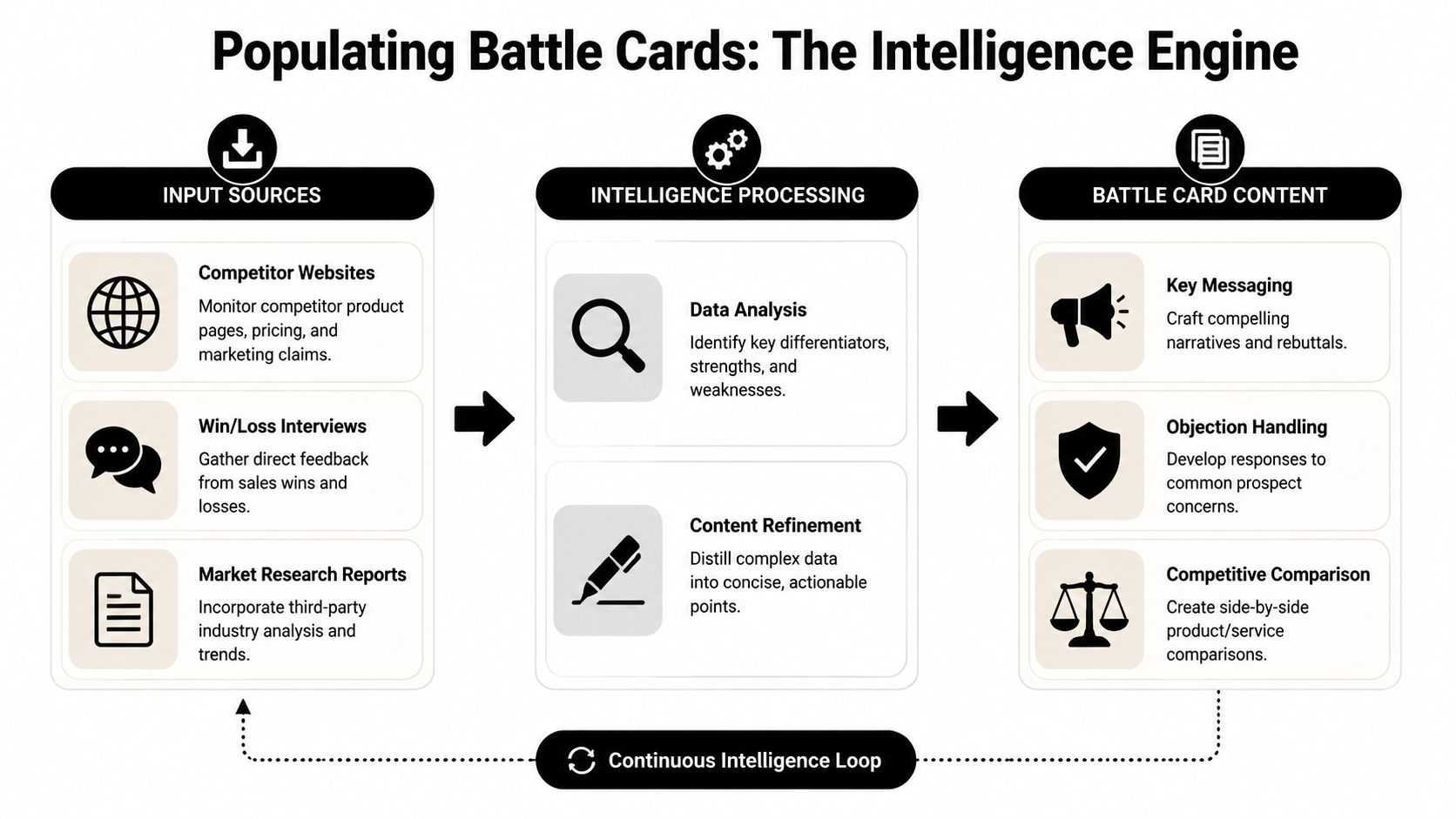
A clean template won't save a weak card. The hard part is feeding it with intelligence that's recent, relevant, and specific enough to change a rep's behaviour. Most bad battle cards fail here. They rely on a one-off research sprint, then sit untouched until someone notices they're wrong.
Modern battle cards work more like living competitive assets. Contify says they can be powered by generative AI and enriched with market intelligence so they become auto-updating resources, and Valona recommends reviewing battle cards every month, as covered in Contify's write-up on transforming sales battlecards.
Where strong content really comes from
The best inputs usually sit across systems, not in one place.
- Win-loss notes: These reveal how buyers describe the competitor in real deals.
- Call recordings and call summaries: Reps hear recurring objections long before a formal enablement review happens.
- Competitor websites and launch pages: Pricing changes, repositioning, packaging shifts, and new claims often show up here first.
- Internal field notes: AEs, SEs, BDRs, and customer success teams all see different parts of the competitive picture.
If your team is reviewing long PDFs, analyst notes, or dense market documents as part of this work, a tool like PDF AI's summarizer guide can help speed up extraction before humans shape the final messaging.
For teams building a repeatable monitoring layer, a dedicated competitive intelligence workflow matters because it keeps source collection from depending on whoever happens to be most proactive that week.
How to turn noise into usable guidance
Raw data is not battle card content. It becomes useful only after someone answers three practical questions:
| Input | Question to ask | What goes on the card |
|---|---|---|
| Competitor launch note | Does this change how they pitch against us? | A revised talk track or warning note |
| Lost deal comments | Did this objection show up more than once? | A stronger objection-handling entry |
| Website pricing change | Will reps hear this on calls soon? | A pricing context note, not a full rewrite |
| Call snippets | Is there a repeatable buyer concern here? | A discovery question or rebuttal |
Good intelligence gets compressed before it gets distributed.
Monthly review is the minimum operating rhythm because competitive claims age fast. But not every update deserves a full card refresh. Some changes should trigger a small edit, a temporary callout, or a rep alert. The discipline is knowing the difference.
What doesn't work is the old create-and-forget model. The minute a seller catches one outdated claim, trust drops. After that, even your accurate cards get ignored.
Automating Battle Card Workflows with Zenfox.ai
Manual upkeep is where battle card programs break. Someone has to notice the change, pull evidence, write the update, route it for approval, publish it in the right place, and tell sales it exists. That's too many handoffs for a process that supports live deals.
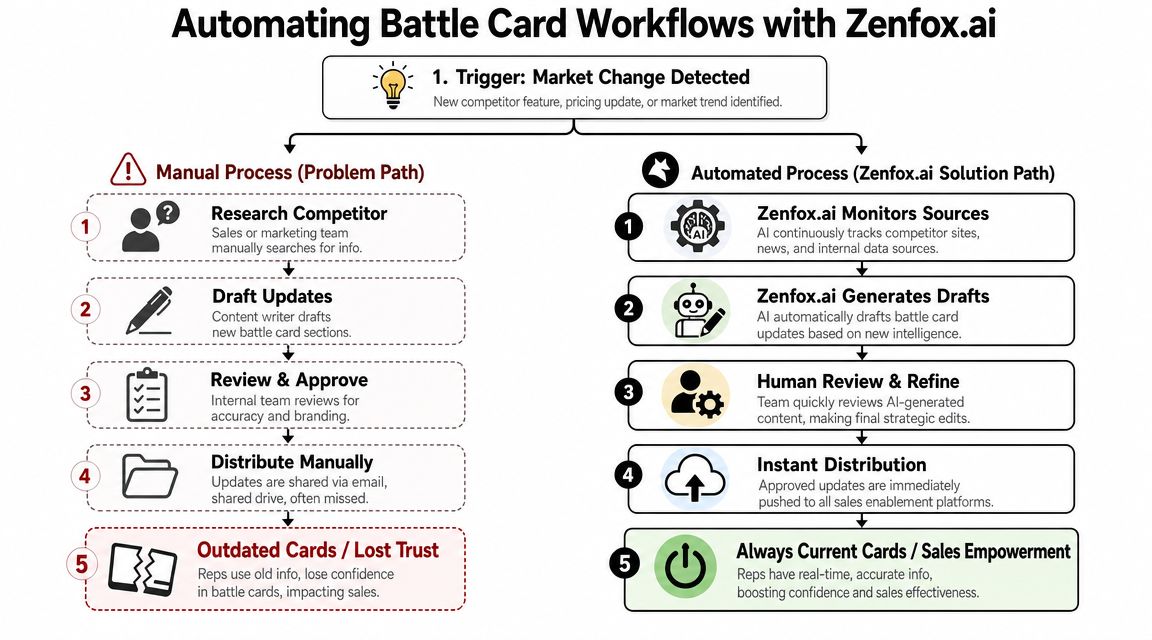
The better model is end-to-end automation with human review at the right point. That means your system monitors inputs, drafts changes, routes them for approval, and distributes updates without relying on memory or manual project management.
What the automated workflow should do
A solid workflow usually starts with a trigger. In practice, those triggers are plain-English operational events:
-
A deal is lost to a named competitor
Pull the CRM notes, attach call summary context, and flag the relevant card for review. -
A competitor changes pricing or packaging
Capture the page change, log the difference, and open a task for the owner of that card. -
A new objection keeps appearing in calls
Cluster similar call snippets and suggest a new objection-handling block. -
A product launch changes your differentiator
Update the draft comparison language, then route it to product marketing or enablement.
In this context, sales automation process design becomes part of enablement, not just pipeline admin. The point isn't to automate messaging blindly. It's to remove the slow, error-prone steps that stop good intel from reaching sellers.
A useful explainer on workflow thinking sits below.
Why governance can't be bolted on later
UK teams have an extra layer of reality to manage. AI in sales workflows raises governance questions, especially when systems touch CRM records, call notes, or internal field intelligence. Highspot's discussion of battle cards highlights the gap clearly: most tools don't address how to use AI to refresh intel from CRMs or call notes without leaking sensitive customer data, which is why a secure, compliant automation platform with auditable workflows matters for UK teams.
That has direct implications for how you build your process:
- Separate source collection from publishing: Not every captured signal should become seller-facing content.
- Require human approval for competitive claims: AI can draft. A human should decide what becomes official guidance.
- Keep an audit trail: If a rep asks where a claim came from, you should be able to trace it.
- Limit data exposure: Customer details and commercially sensitive notes shouldn't flow into uncontrolled content workflows.
The safest automation isn't the one that writes the most. It's the one that shows its work, limits access, and keeps humans in the approval loop.
That's the missing layer in most battle cards sales advice. Automation isn't just about speed. It's how you make the program sustainable without turning your enablement team into full-time content janitors.
Distributing Cards for Maximum Sales Impact
Distribution is where good battle cards either become revenue assets or disappear into storage. Reps won't go hunting through nested folders during a live objection. If the card isn't embedded in the workflow, adoption stays patchy no matter how good the content is.

Put the card where the rep already works
The strongest distribution setup has three layers.
First, put the battle card inside the CRM at the opportunity level when a competitor is tagged. That's the highest-value placement because it matches the deal context.
Second, maintain a central searchable library for onboarding, planning, and pre-call prep, housing broader competitive learning.
Third, push important updates into the channels sellers watch, such as Slack, deal rooms, or team alerts. A meaningful change should reach the field without the rep needing to remember to check.
Treat distribution as part of enablement
A few practical rules keep usage high:
- Make retrieval fast: Reps should reach the card in a few clicks, not after a keyword scavenger hunt.
- Use naming conventions that match how sellers think: Competitor name first. Then deal context if needed.
- Show what changed: If a card is updated, call out the edit so reps don't have to compare versions manually.
- Retire old versions visibly: Nothing damages confidence like multiple conflicting files with similar names.
A central repository still matters, but shared drives alone don't solve the last-mile problem. Sellers use what's closest to the workflow in front of them. That's why CRM delivery, searchable knowledge access, and targeted alerts work better together than any one channel on its own.
Your Battle Card Strategy FAQ
Good battle card programmes usually run into the same set of questions once the basics are in place. The answers below are the ones that matter most in practice.
Battle Card Strategy FAQ
| Question | Answer |
|---|---|
| How often should battle cards be updated? | Review them monthly as a baseline. Outside that cadence, update sooner when there's a meaningful pricing shift, product launch, repeated objection pattern, or positioning change. |
| What's the biggest mistake teams make? | They publish stale or weakly verified intel. Once sellers catch one bad claim, trust drops fast and usage follows. |
| Should a battle card include feature-by-feature comparisons? | Usually not as the core of the card. Feature grids often create clutter and push reps into unhelpful product wars. Keep the focus on positioning, buyer concerns, and objection handling. |
| Who should own battle cards? | One accountable owner is better than committee ownership. But the content should draw from sales, product marketing, competitive intelligence, and field feedback. |
| Can battle cards help outside live calls? | Yes. They're useful for onboarding, pre-call prep, account planning, manager coaching, and win-loss reviews. |
| What should never go on a card? | Unverified claims, outdated pricing assumptions, vague hype, or language a rep would never use in a real conversation. |
| How do you know if a card is working? | Look at how often it gets used in competitive deals, whether reps reference it in call prep, and whether the guidance improves objection handling and deal execution qualitatively over time. |
The simplest test is still the best one. Hand the card to a strong rep five minutes before a competitive call. If they say “this helps”, you're close. If they say “this is too much” or “this is already out of date”, fix the process, not just the copy.
If your team is tired of stale PDFs, scattered intel, and manual battle card updates, Zenfox.ai is the practical next step. It can automate the messy parts of the workflow, from monitoring competitor changes to routing updates and distributing approved content securely, so your reps get current guidance without your enablement team chasing the process by hand.