ChatGPT for Business Automation: What It Can Do Alone vs What Needs a Dedicated Agent Platform
You've probably already used ChatGPT to draft an email, summarize a document, or sketch out a sales script. It works. But it's not automated.
- What ChatGPT Actually Does Well for Business
- Where ChatGPT Hits a Wall
- The Automation Ceiling
- What a Dedicated Agent Platform Does Differently
- A Practical Comparison
- Where Zenfox Fits
- When ChatGPT Is Enough
- The Right Tool for the Right Layer
- Frequently Asked Questions
You've probably already used ChatGPT to draft an email, summarize a document, or sketch out a sales script. It works. It's fast. And at some point, you started wondering whether you could run more of your business through it.
That's a reasonable instinct. But there's a gap between "ChatGPT helped me write this" and "ChatGPT ran this process for me." That gap is what this article is about.
What ChatGPT Actually Does Well for Business
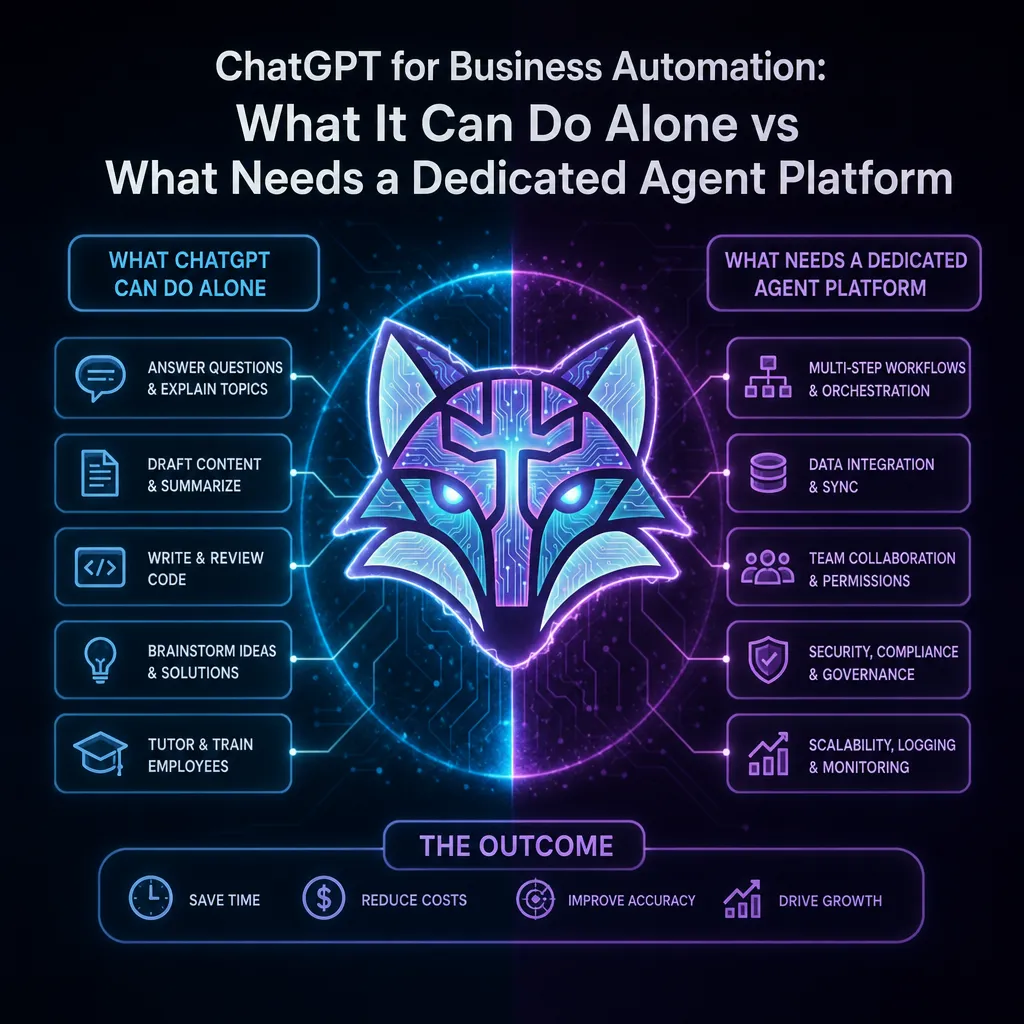
ChatGPT is a language model. Its core strength is generating, transforming, and analyzing text — and for business use, that covers a lot of ground.
Writing and editing — First drafts of proposals, cold emails, job descriptions, internal memos, product descriptions. ChatGPT produces solid first drafts quickly and responds well to revision instructions.
Summarization — Paste in a long transcript, a PDF, or a wall of notes. Ask for key points, action items, or a one-paragraph summary. This works reliably.
Ideation and research framing — Brainstorming campaign angles, structuring a competitive analysis, outlining a report. ChatGPT is a strong thinking partner for this kind of work.
Template and formula generation — Spreadsheet formulas, SQL queries, email sequences, objection-handling scripts. If you can describe what you want, ChatGPT can produce a usable version fast.
For solo operators and small teams, the time savings here are real. But this is also where the story gets more complicated.
Where ChatGPT Hits a Wall
Here's the honest version: ChatGPT is a conversation interface. It responds to prompts. It doesn't take actions, connect to your tools, or run in the background while you're doing something else.
That distinction matters more than it sounds.
It doesn't connect to your systems. ChatGPT can't pull your open deals from HubSpot, check who hasn't responded in 14 days, and draft follow-up emails for each one. You can ask it to write the email template. But you're the one who has to find the contacts, paste them in, and send the messages.
It doesn't execute. There's no action layer. ChatGPT produces text. Moving that text into your CRM, your Slack channel, your Google Doc, or your outbox is still your job.
It doesn't run continuously. ChatGPT doesn't wake up at 7am to check your pipeline, notice a deal went cold, and flag it in Slack. It responds when you open a tab and type something.
It forgets context between sessions. Unless you're using a specific memory feature or a custom GPT with persistent state, each conversation starts fresh. For ongoing business processes, that's a significant limitation.
It can't handle multi-step workflows across tools. This is the core gap. A real business process — pulling data from Airtable, enriching it, creating a summary doc in Google Drive, and notifying your team in Slack — requires coordinating multiple systems. ChatGPT doesn't do that.
The Automation Ceiling
Most teams hit the ceiling in one of two ways.
The first is the copy-paste loop. ChatGPT generates something useful, and you manually move it into the tool where it actually needs to live. You do this dozens of times a week. The AI saves you thinking time, but not execution time.
The second is the context-switching problem. ChatGPT for drafts, Zapier for some triggers, your CRM for data, your inbox for follow-ups. Nothing talks to anything else. You become the integration layer.
Neither of these is automation. They're assisted manual work.
What a Dedicated Agent Platform Does Differently
An agent platform doesn't just generate text. It takes actions across your connected tools, in sequence, toward a defined goal.
The difference is architectural. ChatGPT is a conversation. An agent is a process.
When you tell an agentic platform to follow up with every HubSpot contact who hasn't responded in two weeks — draft a personalized email for each one and queue them for review — it does exactly that. It pulls the contacts, checks the activity history, drafts the emails, and presents them to you before anything gets sent.
You review. You approve. The emails go out.
That's not a chatbot. That's a system doing work.
What Agents Handle That ChatGPT Can't
- Cross-tool execution — Pulling data from one system, transforming it, and writing it into another.
- Background operation — Running processes while you're offline, on a schedule, or triggered by an event.
- Human-in-the-loop approval — Staging outputs for your review before anything touches live systems.
- Persistent goals — Carrying a multi-step objective through to completion across sessions and tools.
- API connections — Authenticating with your tools, handling credentials, and managing data flow between them.
This is the category of work ChatGPT was never designed to handle. It's also where small teams lose the most time.
A Practical Comparison
| Task | ChatGPT Alone | Dedicated Agent |
|---|---|---|
| Draft a follow-up email | Yes | Yes |
| Pull overdue deals from HubSpot | No | Yes |
| Send follow-ups automatically | No | Yes (with approval) |
| Summarize a document | Yes | Yes |
| Write a weekly pipeline report | Partially (you provide data) | Yes (pulls data, writes, delivers) |
| Run in the background overnight | No | Yes |
| Connect to Gmail, Slack, Notion | No | Yes |
| Stage outputs for human review | No | Yes |
The pattern is consistent. ChatGPT handles the language layer. Agents handle the execution layer.
Where Zenfox Fits
Zenfox is built specifically for the execution layer. It's not a chatbot and it's not a workflow builder. You state a goal in plain language, Zenfox breaks it into steps, runs each step across your connected tools, and stages every output for your review before anything is committed to live systems.
That last part matters. A lot of teams are nervous about giving an AI agent access to their CRM, their inbox, or their Slack. The human approval gate is what makes that safe. Nothing executes without your sign-off.
The integrations are real and broad — Gmail, Slack, HubSpot, Google Drive, Notion, GitHub, Stripe, Shopify, Airtable, Twilio, OpenAI, and over 3,000 more. You connect the tools you already use. Zenfox handles authentication, schema generation, and credential storage automatically.
Background agents run 24/7. You don't have to be in the app for work to happen.
For teams that have explored AI agent builder options and found them too technical to configure, Zenfox's plain-language approach removes the setup overhead entirely. And if you want a direct side-by-side look at how the tools compare, the ChatGPT vs Zenfox breakdown covers the specifics in detail.
When ChatGPT Is Enough
To be fair: not every business need requires an agent platform.
If your use case is primarily content generation, document drafting, or one-off research, ChatGPT handles that well. If you're a solo operator who needs a thinking partner more than a workflow engine, a chat interface is the right tool.
The signal that you've outgrown it is usually time. When you're spending more time moving ChatGPT outputs into your actual systems than you're saving by using it, you've hit the ceiling.
That's when the question shifts from "how do I use AI better" to "how do I get AI to do the work."
The Right Tool for the Right Layer
ChatGPT is excellent at what it was built for. The mistake is expecting it to do something it was never designed to do.
Language generation and business execution are different problems. A model that produces great text doesn't automatically become a system that runs your operations. The gap between those two things is where most teams are stuck right now.
If you're ready to move past the copy-paste loop, Zenfox starts free — no credit card required, unlimited connectors from day one. You can also explore how it handles automating customer service workflows as a concrete example of what cross-tool execution looks like in practice.
Frequently Asked Questions
Can ChatGPT automate business processes on its own? ChatGPT can assist with language tasks — drafting, summarizing, generating content. It can't connect to your business tools, execute actions across systems, or run in the background. For true process automation, you need a platform with an execution layer that connects to your actual tools.
What's the difference between ChatGPT and an AI agent for business automation? ChatGPT responds to prompts and produces text. An AI agent takes actions across connected tools, runs multi-step processes, and can operate continuously in the background. The core difference is execution: agents do work, not just generate content.
Is it safe to give an AI agent access to my CRM and email? It depends on the platform. Platforms with structured human approval gates — like Zenfox — stage every output for your review before anything touches live systems. Zenfox is also SOC 2 certified, GDPR compliant, and uses AES-256 encryption via Infisical for credential storage.
When should I use ChatGPT instead of a dedicated agent platform? Use ChatGPT when your need is primarily content generation, one-off research, or drafting. Move to a dedicated agent platform when you need cross-tool execution, background operation, or repeatable multi-step workflows that connect your actual business systems.
Can I use ChatGPT and an agent platform together? Yes. Many agent platforms, including Zenfox, integrate directly with OpenAI. You can use ChatGPT's language capabilities as part of a broader automated workflow, with the agent handling the execution layer around it.
What kinds of business tasks are best suited for an agent platform? Sales follow-up sequences, CRM updates, weekly reporting, research compilation, lead enrichment, and any process that requires pulling data from one tool and writing it into another. These are tasks where the bottleneck is execution, not thinking.
How do I know if I've outgrown ChatGPT for business automation? The clearest signal is time spent on manual handoffs. If you're regularly copying ChatGPT outputs into other tools, re-entering data, or running the same prompt sequence every week, you're doing work that an agent platform would handle automatically.