Why Sending Your Business Data to External AI Models Is a Security Risk
"Every time your AI agent runs a task, something else happens in the background. Your data leaves.
- The Architecture Most Platforms Don't Show You
- Openclaw and Hermes: What's Actually Happening
- The Risks Are Specific, Not Theoretical
- GDPR, Data Residency, and the Compliance Problem
- Keep the Data Inside
- What You're Actually Trading Away
- Frequently Asked Questions
Every time your AI agent runs a task, something else happens in the background. Your data leaves.
Not because someone made a mistake. Not because a vendor was careless. Because that's how most AI agent platforms are built. The data has to leave for the system to work. That's the structural problem — and it's one most platforms selling you automation tools would rather not explain clearly.
This article does.
The Architecture Most Platforms Don't Show You
When you use an AI agent platform, you're not just using one piece of software. You're using a chain of services, each handling a portion of your data.
Here's what that chain typically looks like:
- You give the agent a goal — "follow up with all leads who haven't replied in five days."
- The platform sends that goal, plus context about your business, to an external large language model (LLM) provider — usually OpenAI or Anthropic.
- The model reasons through the task and returns instructions.
- The platform executes those instructions using your connected tools.
- Everything the agent learned — about your contacts, your tone, your workflows — gets stored in an external memory service so it can be recalled next time.
Steps 2 and 5 are where your data leaves your environment. Both are structural. Neither is optional in platforms built this way.
The memory layer is where things get particularly opaque. Services like Honcho — which several agent platforms use for cross-session memory — don't just store a single model's output. Honcho routes your data through a panel of models to build and maintain context about you and your business. So your data isn't passing through one external provider. It's passing through several, in a chain you don't control and probably can't fully audit.
Openclaw and Hermes: What's Actually Happening
Openclaw and Hermes have attracted genuine interest from small business operators and solo professionals who want capable, autonomous agents. Both are worth understanding clearly — not to dismiss them, but because their architecture is where the risk lives.
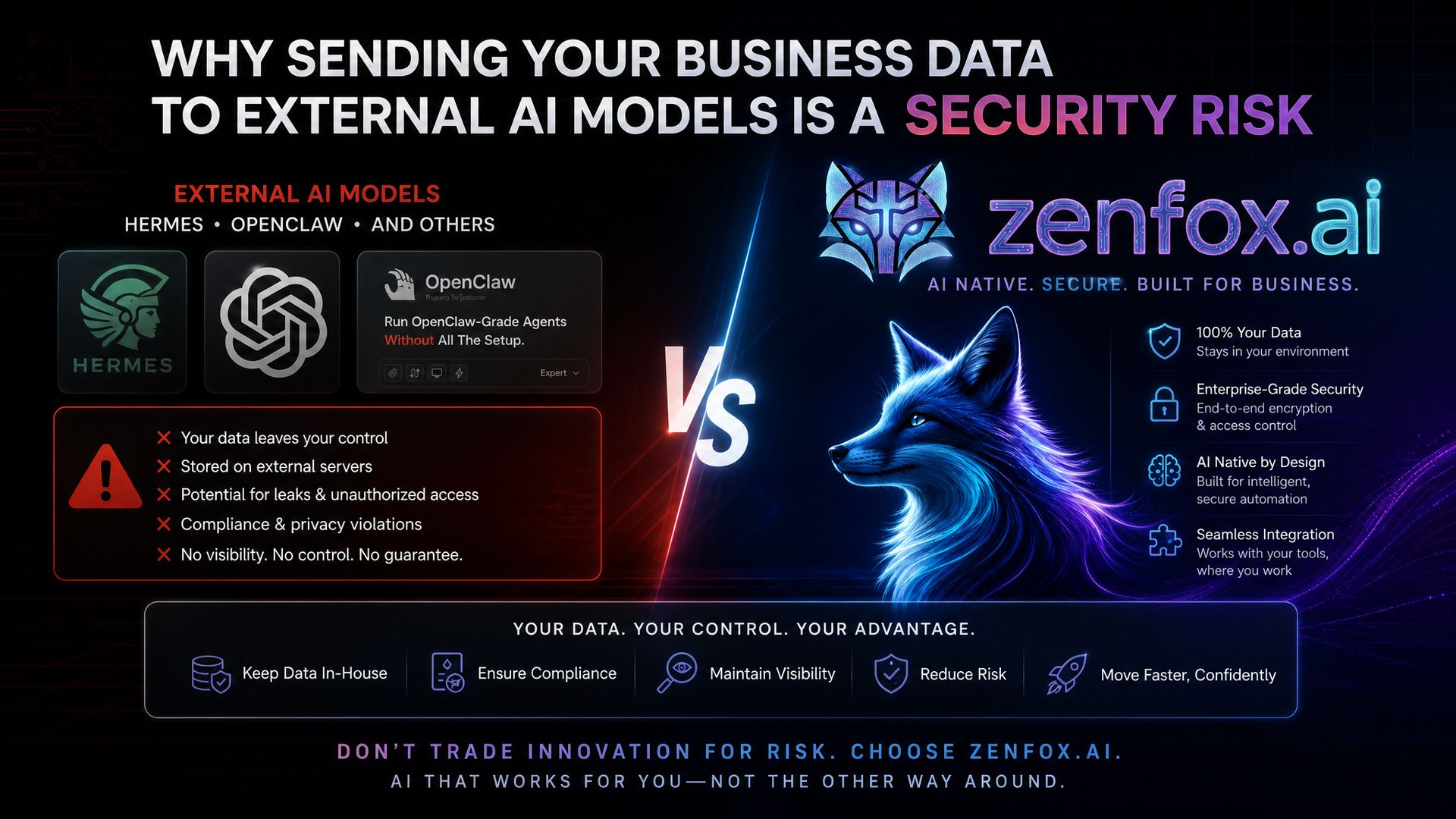
Both platforms route agent tasks to external LLM providers. When your agent runs, your prompts, your data, and your business context go to OpenAI or Anthropic's infrastructure. That's not a bug. It's how they're built.
Both also rely on Honcho for cross-session memory. Honcho's job is to make agents smarter over time by remembering what they've learned about your business. That's genuinely useful. The trade-off is that the memory layer sits outside your environment, managed by a third party, processed through multiple models.
Every agent run on these platforms is a data transfer event. Multiply that by the number of tasks your agent handles daily, and you're looking at a continuous stream of sensitive information — customer records, internal ops data, sales pipeline details, proprietary business logic — flowing out of your environment and through infrastructure you don't own.
The Risks Are Specific, Not Theoretical
It's easy to wave at "data security concerns" without naming what could actually go wrong. Here are the specific risk surfaces.
Prompt content exposure. Every instruction you give your agent, and every piece of context it uses to complete a task, is sent as a prompt to an external API. That prompt may contain customer names, deal values, internal pricing, or strategic plans. API providers have policies about data retention and training use — but policies change, and you're relying on a third party to enforce them.
Memory service compromise. External memory services are attractive targets. They hold structured, contextualised knowledge about your business — exactly the kind of intelligence that's valuable to a bad actor. A breach at a memory provider doesn't just expose a single interaction. It exposes accumulated business context built over months of agent activity.
Multi-model chaining. When your data passes through a pipeline involving multiple models — as it does with Honcho's architecture — each model in the chain is an additional exposure surface. You're not just trusting one provider's security posture. You're trusting all of them, simultaneously.
Vendor policy drift. The terms under which external providers handle your data can change. A provider that doesn't train on API data today may update its terms tomorrow. You may not notice. Your data is already there.
None of these are hypothetical edge cases. They're predictable consequences of an architecture that externalises data handling.
GDPR, Data Residency, and the Compliance Problem
If you operate in the UK or EU — or handle data from customers who do — the data flows described above create a direct compliance problem.
Under UK GDPR and EU GDPR, you're responsible for knowing where personal data goes, who processes it, and under what legal basis. When your AI agent sends customer data to an external LLM provider, that provider becomes a data processor. You need a Data Processing Agreement (DPA) in place. You need to know where that data is stored geographically. You need to be able to demonstrate compliance if asked.
Most small business operators using agent platforms haven't worked through this chain. They've signed up for a tool, connected their CRM, and started running tasks. The compliance obligations don't disappear because the architecture was invisible.
Data residency compounds this. If your data is processed on infrastructure in the United States and your customers are in the UK or EU, you're dealing with international data transfer rules. The legal mechanisms — Standard Contractual Clauses, adequacy decisions — exist, but they require active management. They don't apply automatically.
The honest summary: if you're using a platform that routes your data through external providers, you have compliance work to do that most platforms won't help you with.
Keep the Data Inside
The structural problem has a structural solution. If your agent platform doesn't send your data to external model providers or external memory services, the exposure surfaces above don't exist.
That's the design principle behind Zenfox. Your data doesn't leave. The agents run in the cloud, but the model infrastructure, the memory layer, and all data handling stay inside Zenfox's environment. No external LLM API calls carrying your business context. No third-party memory service accumulating knowledge about your operations.
What that means in practice:
- Customer data used in a sales follow-up task stays inside Zenfox. It doesn't go to OpenAI or Anthropic.
- The context your agents build over time — your tone, your workflows, your business logic — is stored internally. It doesn't pass through Honcho or any equivalent service.
- When your agent chains multiple steps together, none of those steps involve external data handlers.
Zenfox is SOC 2 certified and GDPR compliant. Credentials are encrypted at rest using AES-256 via Infisical. These aren't claims bolted onto a product built for something else. They're the result of building data containment into the architecture from the start.
For GDPR purposes, this simplifies your compliance position considerably. Your data stays in a single, auditable environment. You know where it is. You can demonstrate that.
What You're Actually Trading Away
The question isn't whether AI agents are useful. They clearly are. The question is what you're giving up to use them.
Platforms that route through external providers are making a trade on your behalf: capability and easy setup, in exchange for your data leaving your environment. That trade may be acceptable to some businesses. For businesses handling sensitive customer data, operating in regulated industries, or simply unwilling to absorb the compliance complexity, it isn't.
The good news is that the trade isn't necessary. You can have capable, autonomous agents — the kind that run sales follow-ups, manage CRM records, produce reports, and handle research tasks end-to-end — without your data leaving your environment.
That's not a future capability. It's available now.
Frequently Asked Questions
What does it mean for an AI agent to "send data to an external model provider"? When an AI agent processes a task, it typically sends a prompt to a large language model via an API. That prompt contains the context the model needs to reason through the task — which often includes customer names, internal data, or business-specific details. Sending that prompt means the data travels to the provider's infrastructure, outside your own environment.
Are OpenAI and Anthropic safe to send business data to? Both have policies stating they don't train on API data by default. But relying on a third party's policy means accepting that the policy could change, that the infrastructure could be breached, and that you have limited visibility into how your data is handled. For businesses with compliance obligations, that's a dependency that's difficult to audit.
What is Honcho and why does it matter? Honcho is an external memory service used by some AI agent platforms to give agents cross-session memory — the ability to remember context about your business across multiple interactions. Because Honcho itself uses a panel of models to process and maintain that memory, your business data passes through multiple external services, not just one.
How does GDPR apply to AI agent data flows? Under GDPR, any third party that processes personal data on your behalf is a data processor, and you need a Data Processing Agreement with them. If your AI agent sends customer data to an external LLM provider, that provider is a data processor. You're also responsible for ensuring any international data transfers comply with applicable rules. Most small business operators haven't mapped this chain explicitly.
What makes Zenfox's approach different from Openclaw or Hermes? Zenfox doesn't route your data through external LLM providers or external memory services. The model infrastructure and memory layer are internal to Zenfox's environment. Your business data — customer records, operational context, proprietary logic — doesn't leave the platform. Zenfox is SOC 2 certified and GDPR compliant, with credentials encrypted at rest using AES-256.
Does keeping data internal limit what AI agents can do? No. Zenfox agents handle the same categories of work — sales follow-ups, CRM management, research, reporting — that external-provider-based platforms do. Data containment is an architectural choice, not a capability trade-off.
How do I know if my current AI agent platform is sending data externally? Check the platform's technical documentation for references to OpenAI, Anthropic, or other LLM providers. Look for mentions of third-party memory services. If the platform doesn't publish a clear data flow diagram, ask directly: "Where is my data processed, and what external services does it pass through?" The answer should be specific. If it isn't, that's informative.
The structural risk is real, and it compounds with every task your agents run. If data leaving your environment is a problem for your business, the right response is an architecture that keeps it inside. You can find out how Zenfox approaches this at zenfox.ai.