
Transform UK Healthcare with Medical Speech Recognition
Guide to medical speech recognition for UK healthcare. Explore technology, accuracy, GDPR, and ROI to reduce admin and improve patient care.
The pattern is familiar across UK healthcare. Clinics have moved to digital records, but clinicians still finish sessions with a queue of notes, letters, coding tasks, and corrections waiting for them. In hospitals, the work often shifts into the evening. In small practices, it spills into lunch breaks and unpaid admin time.
That’s why medical speech recognition keeps coming up in board meetings, digital strategy reviews, and procurement discussions. The promise is simple enough: let clinicians speak naturally, turn speech into usable clinical documentation, and give time back to patient care. Its deployment, however, is more complicated. Some deployments work well. Some fail because the software isn’t the main problem. Workflow, accents, data handling, EHR integration, and local governance usually decide the outcome.
For UK providers, the biggest mistake is treating this as a generic productivity tool. It isn’t. Medical speech recognition sits inside clinical risk, information governance, and operational design. If you choose it well, configure it properly, and roll it out with discipline, it can remove a meaningful share of documentation friction. If you buy on headline claims alone, you can end up with expensive software that clinicians leave unused.
Table of Contents
- Ending the Tyranny of Clinical Paperwork
- How Medical Speech Recognition Actually Works
- Clinical Use Cases and Integrated Workflows
- Understanding Accuracy Metrics and Benchmarks
- Navigating UK Privacy and Regulatory Hurdles
- How to Evaluate and Choose the Right Solution
- Common Pitfalls and How to Mitigate Them
- The Future of Clinical Documentation and Automation
Ending the Tyranny of Clinical Paperwork
At 6:30 pm, the clinic is over but the work is not. A GP is still finishing consultation notes. A registrar is catching up on discharge summaries before handover. In many organisations, that unpaid or overstretched documentation time is treated as normal operations when it is really a capacity problem.
For UK providers, clinical paperwork affects far more than clinician frustration. It affects access, coding quality, letter turnaround, rota pressure, and retention. Leaders can see the symptoms without a dashboard. Notes sit incomplete. Secretarial queues grow. Follow-up communication slows down. Staff leave late to finish records that should have been completed during the clinical day.
Speech recognition earns its place when it reduces that backlog in real workflows. The point is not to add another digital layer. The point is to let clinicians document at the speed of care, inside the systems they already use, with little enough correction that the time saving survives contact with real practice.
That is where the UK context matters. Accent variation is wider than many buyers expect. A product that performs well in a polished demo can struggle with regional accents, fast ward-round dictation, mixed clinical terminology, or clinicians switching between NHS and private settings. The operational question is simple. Does it reduce effort on a Tuesday afternoon in a noisy department, not just in a vendor test environment?
Where the burden shows up
The pressure looks different across settings, which is why blanket rollouts often disappoint.
- General practice: consultation notes, referral letters, medication changes, and inbox-related follow-up
- Acute care: ward round notes, discharge summaries, clinic letters, and handover documentation
- Diagnostics: repetitive reporting where turnaround time and consistency both matter
- Private practice: documentation linked directly to billing, insurer communication, and patient correspondence
I usually advise organisations to map the highest-friction documentation tasks before they buy anything. A radiology team reporting high volumes has different needs from a GP surgery trying to cut evening admin, and both differ again from a trust focused on discharge delays.
Practical rule: If clinicians still need to retype, heavily reformat, or paste text across systems, you haven’t fixed documentation. You have shifted the effort.
Why boards and owners should care
Hospital administrators tend to assess speech recognition through throughput, workforce pressure, and documentation quality. Practice owners usually look first at clinician time, staffing costs, and whether notes are finished fast enough to support smooth billing and communication. Both views are reasonable, and both point to the same test. Does voice documentation remove work from the process, or does it create new review work elsewhere?
The best results usually come from targeted deployment. Start where documentation volume is high, template use is predictable, and the EHR can accept dictated text without awkward copying between systems. In the NHS, that often means checking integration constraints early, especially where legacy EPRs, clinic letter workflows, or local desktop builds limit what can be deployed safely.
The commercial case is rarely just fewer keystrokes. It is faster record completion, fewer delays downstream, cleaner source material for coding and admin teams, and less clinician time lost after hours. If those gains are not visible in the first pilot area, the problem is usually not clinician resistance alone. It is poor workflow fit, weak integration, or unrealistic assumptions about accuracy across real UK speech patterns.
How Medical Speech Recognition Actually Works
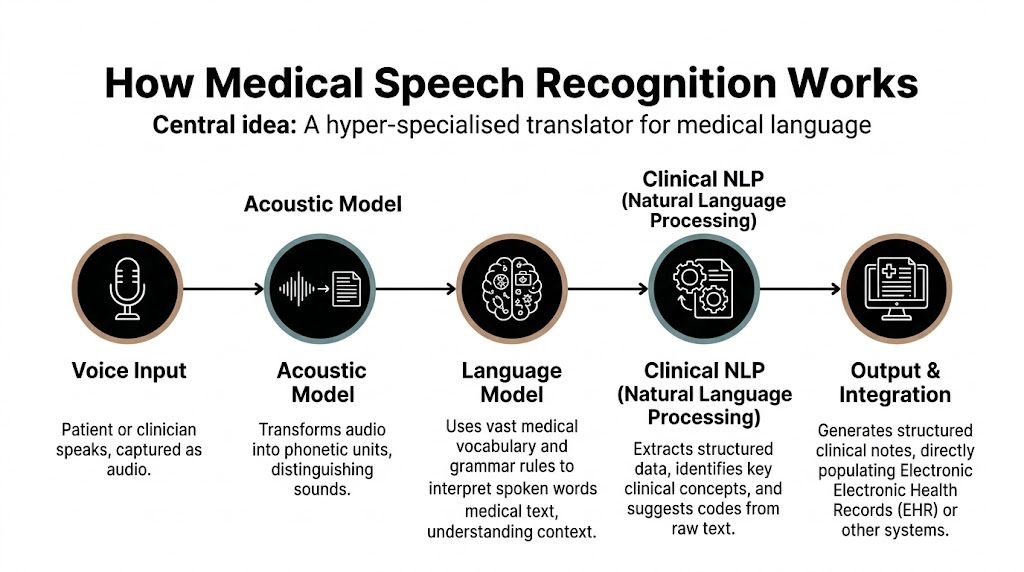
A good way to think about medical speech recognition is as a hyper-specialised translator. It doesn’t just hear English. It has to recognise clipped clinical speech, abbreviations, drug names, anatomy, and context that changes meaning from one specialty to another.
A general voice assistant might hear “MI” and struggle. A medical system should understand that in a cardiology context, it may mean myocardial infarction. That difference is why healthcare organisations shouldn’t evaluate these tools as if they were standard consumer dictation products.
The core pipeline
Medical speech recognition usually runs through several layers.
First, the Automatic Speech Recognition (ASR) engine captures audio and breaks speech into smaller sound units. According to Shaip’s explanation of medical speech recognition, this includes phoneme segmentation against extensive medical vocabularies.
Second, the language model decides what those sounds most likely mean in context. Specialty vocabulary is thus critical. Drug names, body sites, abbreviations, and common dictation patterns all affect the output.
Third, clinical NLP may structure the text further. That can include formatting sections, extracting concepts, or helping map narrative language into more structured documentation.
Shaip also notes that Google’s MedASR was trained on approximately 5,000 hours of physician dictations, and that modern systems use SpeechLLMs to fine-tune and format medical entities with high precision in clinical output.
Why ordinary speech tools struggle
In day-to-day clinical work, speech is rarely neat. People interrupt themselves. They correct mid-sentence. They switch between shorthand and formal terminology. A radiologist, GP, surgeon, and psychiatrist all sound different when documenting.
Medical speech recognition has to cope with:
- Dense terminology: drug names, procedures, anatomical terms, acronyms
- Variable pace: some clinicians dictate carefully, others speak fast and elliptically
- Context shifts: the same abbreviation can mean different things in different specialties
- Messy environments: wards, clinics, and theatres are not quiet recording studios
A product demo often hides these realities. Vendors tend to show a clean microphone, a prepared speaker, and ideal room conditions. Real deployment means handling dictation in consulting rooms, semi-open offices, and busy clinical areas where background sound and interruptions are normal.
The strongest systems aren’t just good at transcription. They’re good at recovering meaning from imperfect speech in imperfect environments.
What administrators should ask about the model
You don’t need to become a machine learning expert to ask sensible questions. You do need to know what separates a healthcare-ready product from a generic one.
Ask vendors whether the model is tuned for medical language, whether it adapts to individual users, and how it handles formatting and downstream structuring. If they can’t explain their medical vocabulary handling in plain language, that’s a warning sign.
For organisations exploring broader platform flexibility, it also helps to think about whether you want one vendor’s closed stack or a more modular setup. That question comes up in many AI decisions, not only speech. A useful parallel appears in this discussion of model and provider platform independence, especially if you’re trying to avoid lock-in while keeping clinical systems adaptable.
Clinical Use Cases and Integrated Workflows
The value of medical speech recognition becomes clear when you stop describing features and start looking at the working day. Different specialties use it differently, and the workflow matters more than the brand name on the contract.
General practice and real-time note entry
In a GP setting, front-end speech recognition is often the most intuitive model. The clinician dictates directly into the patient record while reviewing symptoms, history, examination, and plan. If the integration is well built, the output lands in EMIS or SystmOne in the right field with minimal copy-paste.
The benefit isn’t just speed. It’s continuity of attention. A GP who can speak the note while maintaining the flow of consultation usually produces more complete documentation than one who postpones everything to the end of clinic.
What tends to work in primary care is concise, structured dictation. Short bursts. Clear sectioning. Immediate correction when needed. What tends not to work is expecting ambient capture to solve every documentation task from day one, especially in cramped rooms with overlapping speech and variable hardware.
Radiology and report-driven specialties
Radiology has long been one of the clearest fits for speech-based workflows because the reporting pattern is repetitive, specialist, and high volume. Clinicians often prefer back-end or highly tuned front-end workflows that support rapid reporting with a standard structure.
The operational advantage here is turnaround. If the system understands specialty vocabulary and report phrasing, clinicians can dictate efficiently and then review rather than compose from scratch. Where these projects fail, it’s usually because the template logic is poor or the correction process is clumsy.
A similar logic applies in pathology and some surgical specialties. Repeated structures help the system, and the system helps the clinician by preserving reporting rhythm.
Virtual care and hybrid clinics
Telehealth introduced a different kind of documentation pressure. Clinicians now have to manage the video platform, patient interaction, note-taking, and follow-up admin in one compressed workflow. Speech recognition helps when it captures the summary without forcing the clinician to constantly look away.
In practice, the most successful virtual workflows use speech recognition as one component of a broader process. The note is created first. Then the follow-up work moves. Referral letters, reminders, task assignment, and admin handoff all matter. That same logic is why many teams also explore workflow tools that can generate connected utilities quickly, such as instant app building for operational use cases, when internal systems need lightweight interfaces around documentation and follow-up.
What an integrated workflow looks like
The strongest implementations usually have these characteristics:
- Clear trigger point: the clinician knows when dictation begins and where the text will land
- Visible review step: the output is checked before final sign-off
- Template support: routine documentation uses structures that reduce ambiguity
- Task routing: downstream work is assigned without relying on memory or manual chasing
When speech recognition feels awkward, the problem is often the workflow around it, not the speech engine itself.
For administrators, the question isn’t whether speech can become text. It can. The question is whether that text enters the clinical process cleanly enough to reduce total effort.
Understanding Accuracy Metrics and Benchmarks
A consultant dictates a clinic letter on a quiet demo call and the transcript looks excellent. The same product is then used on a respiratory ward in Manchester, with masks, background noise, mixed accents, and a junior doctor speaking quickly between bleeps. That is the accuracy test that matters.
Headline accuracy figures often hide the underlying implementation risk. Vendors usually lead with Word Error Rate, or WER, which measures substitutions, omissions, and insertions against a reference transcript. WER is useful, but it is only a starting point. In clinical use, all errors do not carry the same risk. Missing "the" is trivial. Confusing "left" with "right", or changing a drug name, creates obvious safety problems.
For UK providers, the practical benchmark is local performance under local conditions. Generic systems often drop in quality when they meet NHS note styles, specialty shorthand, overlapping speech, and accent variation across England, Scotland, Wales, and Northern Ireland. A model that performs well with US training data may still need substantial tuning before it is reliable in a UK outpatient clinic or trust setting.
That is why buyers should ask for more than a single accuracy number.
What to measure instead of accepting the headline claim
A useful evaluation breaks accuracy into separate categories, because each one affects operations differently.
| Accuracy area | Why it matters clinically | Common failure mode |
|---|---|---|
| Vocabulary accuracy | Clinical terms must be captured correctly | Drug names, abbreviations, and anatomy mistranscribed |
| Context accuracy | Meaning depends on specialty and sentence context | Shorthand interpreted incorrectly |
| Formatting accuracy | The output must be usable inside the record | Text appears as an undifferentiated paragraph |
| Speaker handling | Multi-speaker encounters need separation | Patient and clinician statements merged |
| Accent resilience | UK services involve wide accent diversity | Performance drops for regional or non-native accents |
Accent resilience deserves explicit testing in the UK. It is not enough to validate against one consultant with a standard southern English accent and call the model "clinically accurate." Primary care networks, mental health services, community teams, and acute trusts all bring different speech patterns. If a supplier has not tested for accent diversity, expect error rates to rise in live use.
The same applies to workflow context. Accuracy in radiology dictation is not the same as accuracy in GP consultations, ED assessments, or MDT discussions. Some engines perform well in highly structured dictation and struggle in conversational capture. That distinction affects staffing, review time, and return on investment.
There is also a procurement point here. Some organisations prefer flexibility if one engine proves stronger in one specialty than another. That is where provider independence across model platforms can become relevant, especially for larger groups that do not want one vendor decision to limit future optimisation.
The benchmark that matters operationally
Administrators should ask a simple question. How much clinician correction is still required per note?
If the draft arrives quickly but needs heavy editing, the advertised accuracy figure has limited value. I have seen deployments where nominal transcription quality looked acceptable, yet clinicians still spent too long fixing medication names, punctuation, headings, and attribution. The product was technically accurate enough to demo well, but not accurate enough to save time at scale.
A stronger benchmark includes:
- performance by specialty
- performance by accent group and speaking pace
- output quality in noisy environments
- error rates for medications, laterality, diagnoses, and numbers
- average editing time per document
- effect on turnaround time and clinician adoption
Buying advice: Require vendors to test with your own clinicians, your own accents, your own templates, and your own record system. A benchmark built on someone else's environment does not predict your rollout.
Navigating UK Privacy and Regulatory Hurdles
A trust can approve the clinical case for speech recognition on Monday and stall the purchase by Friday because information governance cannot sign off the data flow. That is common in the UK. If a supplier cannot explain where patient-identifiable data is processed, who can access it, how long it is retained, and how the audit trail works, the project will slow down regardless of how strong the demo looked.
UK buyers also face problems that generic US material tends to skip. Accent diversity is wider. NHS environments often depend on EMIS, SystmOne, or trust-specific EPR configurations that do not behave like a clean demo build. GDPR obligations and DSPT expectations turn deployment design into an operational issue, not a legal footnote.
Why adoption slows in primary care
Primary care is a good example. A speech engine may perform well in controlled testing, but adoption drops when the workflow depends on copying text between systems, when the vendor has weak answers on cloud processing, or when GPs find the product handles some accents and consultation styles better than others.
One of the more grounded UK-specific examples comes from AssemblyAI’s discussion of medical speech recognition software, which points to security concerns around cloud-based ASR and integration issues with EMIS and SystmOne as barriers in UK primary care. Those are familiar blockers. In practice, governance teams are usually less worried about the headline promise than about the unanswered operational detail.
I have seen this pattern repeatedly. Clinical users may be ready to pilot. IG, procurement, and IT support then ask basic questions that should have been answered at the start, and the rollout loses momentum.
The compliance questions that matter in procurement
Hospital administrators and practice owners should keep the review practical:
- Data processing location: Where are audio and transcripts processed, stored, and backed up?
- Data residency and transfers: Does any patient-identifiable information leave the UK, and under what contractual basis?
- Contracts and subprocessors: Is there a clear data processing agreement, with named subprocessors and defined responsibilities?
- NHS security alignment: Can the supplier support DSPT-related reviews and provide material your IG team can assess?
- Access controls: Who can listen to recordings, read transcripts, export data, or administer users?
- Audit logs: Can your organisation see who accessed what, when, and for what purpose?
- Retention and deletion: Can retention periods be set to match local policy, and can data be deleted on request?
- Incident handling: What happens if there is a breach, a misdirected transcript, or a failed integration?
Vague answers create work later. “GDPR compliant” is not a sufficient answer. Neither is “secure cloud” without detail on hosting, support access, logging, and deletion.
Cloud, local hosting, and the real trade-off
Cloud deployment can reduce setup time and make updates easier. That benefit is real. It also introduces review points that many suppliers underestimate, especially in NHS organisations with stricter local governance or a low tolerance for external processing of patient-identifiable data.
Some providers will accept cloud speech recognition if the controls are clear and the contracts are strong. Others will prefer tighter hosting arrangements, isolated tenancy, or architecture that limits where raw audio travels. That is a governance decision tied to risk, support capacity, and procurement policy.
The right review starts early and stays concrete. Ask for architecture diagrams, data flow maps, admin role definitions, retention settings, and support access procedures. Ask for policy documents your IG lead can read without a sales call. A published data safety policy for healthcare data handling is the kind of baseline material any serious supplier should be ready to provide.
Compliance work started early saves time. It filters out products that would fail governance review after clinicians have already invested effort in testing them.
How to Evaluate and Choose the Right Solution
Most buying mistakes happen because teams compare products at the wrong level. They compare slogans instead of workflows. The right evaluation process is less about who has the loudest AI story and more about whether the system fits your clinical environment, governance model, and support capacity.
A large trust and a five-clinician practice shouldn’t buy in the same way. A trust may care most about integration depth, user provisioning, and specialty variation across departments. A smaller practice may care most about ease of setup, support quality, and whether the software saves time without adding IT overhead.
Vendor evaluation checklist
| Criterion | What to Look For | Red Flags |
|---|---|---|
| Accuracy in your setting | Live testing with your clinicians, your specialties, and your documentation styles | Vendor relies on generic demo scripts or refuses local pilot testing |
| EHR integration | Proven compatibility with your record system and clear field-level workflow | Output requires repeated copying, pasting, or manual reformatting |
| UK compliance support | Clear answers on residency, access control, audit, contracts, and governance | “GDPR compliant” with no operational detail |
| User experience | Fast correction workflow, minimal training burden, and sensible microphone support | Too many commands, awkward editing, or slow response |
| Deployment model | A hosting approach your governance team can approve | No flexibility around data handling requirements |
| Training and support | Named support path, onboarding plan, and clinician feedback loop | Vendor disappears after contract signature |
| Total cost of ownership | Licensing, implementation effort, support, hardware, and change management considered together | Price looks low until integration and remediation costs appear |
What to test during a pilot
A pilot should be narrow enough to manage and broad enough to reveal problems. One department, one specialty, or one practice site is usually better than an organisation-wide splash launch.
Focus the pilot on a few questions:
- Can clinicians create usable notes faster than before?
- How much correction is required for real cases?
- Does the workflow reduce total admin effort, not just typing?
- Can governance and IT support the chosen deployment model without exceptions piling up?
Don’t overcomplicate the scorecard. A pilot succeeds when clinicians keep using the tool voluntarily because it helps them complete work.
What small practices often overlook
Small organisations sometimes assume the cheapest product is the safest choice. It often isn’t. If support is weak, integration is shallow, and governance questions remain unresolved, a lower sticker price can become a more expensive failure.
What usually works for smaller teams is a limited rollout with one or two committed users, clear note types, and a simple review habit. What doesn’t work is forcing every clinician to adopt a new dictation style overnight.
The best buying signal is sustained clinician use after the novelty disappears.
Common Pitfalls and How to Mitigate Them
Most failed medical speech recognition projects don’t fail because speech-to-text is impossible. They fail because buyers underestimate the messy details of clinical work. Accent diversity, room noise, inconsistent templates, weak onboarding, and poor expectations will sink a rollout faster than any glossy brochure suggests.
Accent recognition is not a side issue
This is one of the most under-discussed issues in the NHS. A PMC-cited review of UK accent challenges notes that word error rates can be 20% to 30% for non-native English accents in NHS contexts. The same source reports 45% satisfaction among non-UK born clinicians, who make up 25% of the NHS workforce.
That should change how leaders evaluate vendors. Accent performance is not a niche concern. It’s central to whether a deployment works fairly across the workforce.
Mitigation starts with procurement. Require testing with a representative mix of clinicians, including international staff and regional accents. Then build a correction process that helps the system adapt without placing an endless burden on users.
Noise and shared clinical spaces
Busy healthcare environments create problems that office dictation products don’t handle well. Doors open. People interrupt. Equipment alarms sound. In some settings, patient and clinician speech overlap.
To reduce avoidable failure:
- Choose the right spaces: start in quieter rooms and controlled workflows before moving into noisier settings
- Standardise hardware: a decent microphone setup often matters more than buyers expect
- Use structured dictation habits: clear section phrasing improves output and speeds review
- Avoid overreach early: don’t treat ambient capture in chaotic spaces as the first rollout phase
Resistance usually reflects bad workflow design
Clinicians rarely resist because they hate technology in principle. They resist when a new tool slows them down, exposes them to risk, or creates extra correction work.
Common warning signs include silent abandonment, notes being typed after dictation “just to be safe”, and one enthusiastic champion carrying a project nobody else wants. The fix is not more promotional training. It’s redesign.
A workable approach includes:
- Targeted onboarding: teach clinicians how to dictate for the specific system, not just how to log in
- Local champions with credibility: choose respected users from the specialty, not just digital enthusiasts
- Short feedback cycles: collect examples of errors and tune templates or vocabularies quickly
- Visible governance sign-off: clinicians adopt faster when privacy and medico-legal questions are answered clearly
If users keep bypassing the system, believe the behaviour. Something in the workflow is wrong.
Overpromising ROI
Another common pitfall is promising dramatic savings before the organisation has done the hard work of integration and change management. That creates distrust. Staff hear one story from procurement and experience another in clinic.
A better approach is to set expectations around progressive improvement. Start with high-burden note types. Measure correction effort. Fix templates. Expand only when the first workflow is stable.
That’s how medical speech recognition becomes an operational asset rather than another underused licence.
The Future of Clinical Documentation and Automation
At 6:30 pm, the clinic list is finished but the work is not. A GP is still checking dictated notes, a secretary is chasing missing follow-up actions, and referral text is being copied into a second system because the first one does not pass structured data cleanly. That is the key next stage for medical speech recognition in the UK. Less focus on faster dictation alone, more focus on whether documentation can trigger safe downstream work inside the systems providers already run.

The direction of travel is clear. Speech recognition is being combined with ambient capture, summarisation, coding support, letter drafting, and task creation. The value comes from reducing the number of times staff have to re-enter the same clinical information across the EPR, document management tools, referral workflows, and booking systems.
In UK settings, the hard part is rarely the transcript itself. The hard part is getting useful output into EMIS, SystmOne, Vision, Epic, Cerner, or a local trust setup without creating extra review burden. Add accent diversity across clinicians and patients, mixed audio quality in busy wards, and strict expectations around GDPR, DSPT, audit trails, and role-based access, and the future looks less like a simple software upgrade and more like a clinical operations project.
From transcription to operational workflow
A mature setup usually follows a pattern like this:
- the consultation or dictation is captured
- a draft note and summary are generated
- the clinician reviews and signs off
- medications, diagnoses, and follow-up items are extracted into the right fields where the workflow allows
- a referral or clinic letter is prepared
- admin teams receive clear tasks instead of free-text handoffs
- the record is updated with an audit trail that stands up to scrutiny
That model matters because it changes where time is saved. The gain is not only faster note production. The gain is fewer handoffs, fewer duplicate entries, and fewer missed actions after the consultation ends.
A short video overview helps illustrate how voice-led documentation is evolving into more connected workflows:
What the next phase will reward
The organisations that get the best return will treat structured output as part of service design. Free text still has clinical value, but structured data is what allows a system to create a task, draft a letter, suggest coding, or route work to the right team.
They will also budget for integration and governance work early. In my experience, projects either become useful or stall at this point. If the product can produce a polished summary but cannot fit local workflows, local templates, and approval rules, staff end up copying and pasting again.
The winners in the UK market are unlikely to be the tools with the best demo alone. They will be the tools that cope with regional accents, perform acceptably in real clinical noise, fit NHS and independent practice systems, and give information governance teams enough control over retention, access, and processor arrangements.
For hospital administrators and practice owners, the decision is broader than dictation. It is a decision about how clinical work moves from conversation to record, and from record to action, with less friction and less risk.
If you’re ready to go beyond transcription and automate the follow-up work that slows teams down, Zenfox.ai is worth a look. It connects the tools your team already uses, turns plain-English instructions into working automations, and helps move work from “note captured” to “task completed” without forcing you into a long development cycle.