
Is Your Data Safe with AI Agents? Security Guide for Enterprise
Is Your Data Safe with AI Agents? Security Guide for Enterprise. Learn core risks like prompt injection, evaluation framework, and UK GDPR compliance for 2026.
The biggest mistake enterprises make with AI agents is treating security as a feature choice. In the UK, it's already a legal design requirement. UK GDPR Article 32 requires organisations to implement measures such as encryption, confidentiality, integrity, availability, and resilience, with controls matched to risk and the “state of the art” for systems handling personal data, as outlined in Metomic's explanation of AI agents and data security. That changes the conversation. If an agent can read inboxes, update customer records, and trigger workflows across multiple systems, the security question starts before procurement and long before go-live.
That's the counterintuitive part. The risk isn't mainly that the model is clever. The risk is that the agent is trusted.
An autonomous agent with access to Gmail, Slack, Drive, HubSpot, or internal documents behaves less like a chatbot and more like a new operational identity inside your business. If that identity is over-permissioned, poorly logged, or fed tainted inputs, it can move sensitive data faster than a human ever could. The right response isn't panic. It's disciplined design.
This guide takes a practitioner's view of Is Your Data Safe with AI Agents? Security Guide for Enterprise. Instead of another generic list of concerns, it uses a four-pillar framework that security teams can apply to any agent platform or deployment model, with particular attention to two gaps many buyers still miss: continuous identity governance and data provenance.
Table of Contents
- The Trojan Horse in Your Tech Stack
- Understanding the Core Security Risks of AI Agents
- Your Four-Pillar Framework for Agent Security Evaluation
- Implementing Essential Security Controls for AI Agents
- Addressing Advanced Threats and Governance Gaps
- Choosing a Secure Platform vs DIY Solutions
The Trojan Horse in Your Tech Stack
AI agents are often introduced as productivity tools. In practice, they're closer to automated insiders. That isn't a rhetorical flourish. It's the simplest way to understand what changes when software stops suggesting actions and starts taking them.
A normal SaaS integration usually does one job with a defined boundary. An agent does something broader. It reads context, chooses tools, chains actions, and often carries delegated access across email, chat, CRM, file storage, and internal systems. That flexibility is where the value sits. It's also where the exposure sits.
For business leaders, the primary issue is trust inheritance. If a trusted employee can see a sales pipeline, customer emails, and a shared drive, the agent may inherit the same access without inheriting human judgement. One malformed instruction, one poisoned document, or one badly scoped connector can turn routine automation into data leakage or unauthorised change.
Practical rule: If an agent can act across systems, assess it like a privileged operator, not like a productivity add-on.
This is why many AI pilots feel safe in demos and become uncomfortable during security review. The demo shows speed. The security team sees cross-system authority, weak runtime governance, and unclear forensic visibility.
The solution isn't to block agent adoption. That usually drives teams towards unsanctioned tools and shadow workflows. The better move is to evaluate agents with a framework that reflects how they behave inside an enterprise. Four pillars matter most:
- Data governance: what the agent can see, store, and process
- Access control: what it can do, where, and under which identity
- Auditability: what you can reconstruct after the fact
- Vendor trust: how much operational burden stays with you
That four-pillar approach makes the conversation concrete. Instead of asking whether AI is “safe”, you ask whether a specific agent is safe enough for a specific workflow, with controls that match the business impact.
Understanding the Core Security Risks of AI Agents
The phrase “AI risk” is often too vague to be useful. Security teams need something sharper. In enterprise environments, the main concern isn't sentience or runaway autonomy. It's that agents connect trusted data to trusted tools and can act at machine speed.
Why agents change the threat model
An employee using HubSpot, Gmail, Slack, and Drive still creates risk, but humans are slow, inconsistent, and visible. Agents are fast, repeatable, and often hidden inside approved workflows. That changes both the blast radius and the detection challenge.
This visual captures the broad attack surface security leaders should have in mind:
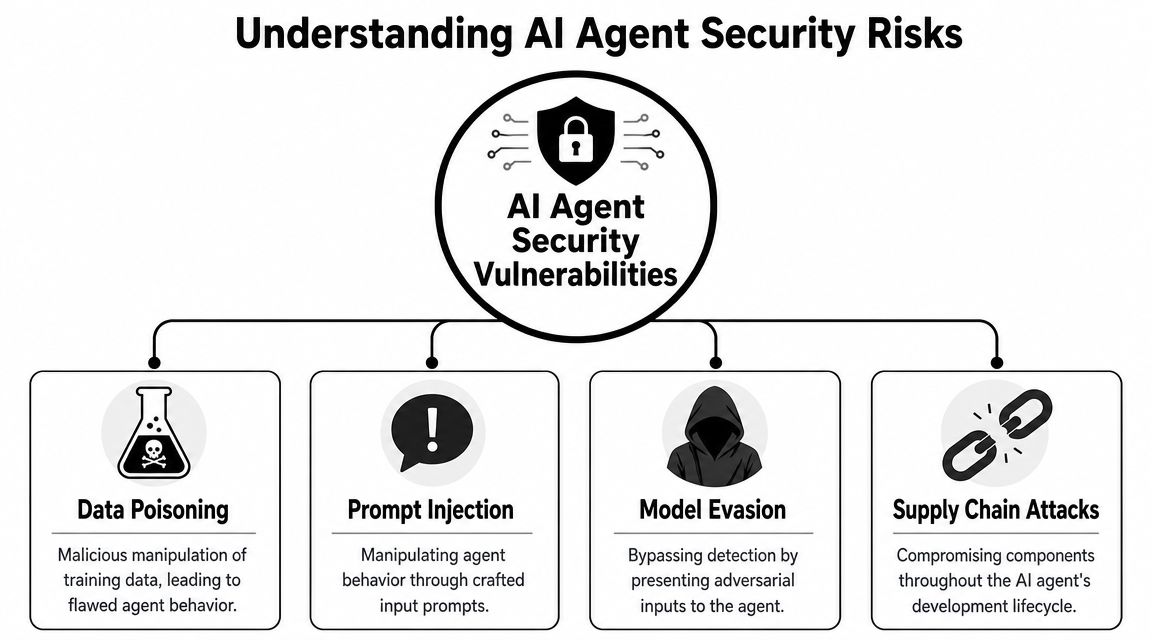
One practical point often gets lost. The danger doesn't require a dramatic external breach. Many failures start with the agent doing exactly what it was allowed to do, just in the wrong context.
Teams building developer-facing automations should also understand how these risks extend into code generation and repository workflows. A useful reference is this guide to AI coding agents, especially if your agent can read tickets, generate code, or interact with engineering tools.
Four risks that matter in practice
Data exfiltration is the first and most obvious risk. An agent that reads a CRM, summarises account activity, and posts updates into Slack can leak customer data without any “hack” in the traditional sense. The issue is usually poor scoping. The agent was allowed to access more records, channels, or destinations than the task required.
Privilege escalation is subtler. A marketing automation agent might start with access to campaign tools and contact data, then pick up additional permissions through inherited service accounts, shared integrations, or convenience-based configuration. Once that happens, the agent can reach systems nobody intended it to touch. Security incidents often start with convenience. “Just connect it to everything so it works” is still one of the worst implementation decisions in enterprise IT.
A short explainer is worth watching because it shows how these attack paths chain together in real deployments:
Prompt injection is a risk widely recognized, yet its potential impact is often underestimated. An agent doesn't need to receive a malicious-looking command from an attacker. It may receive an email, a document, or a chat message that looks routine yet contains hidden instructions intended to alter the agent's behaviour. If the agent can read that content and then call tools, the malicious input becomes operational.
Insecure outputs complete the picture. Agents don't just consume data. They generate reports, summaries, code, updates, and recommendations. Those outputs can contain errors, unsafe actions, or leaked context from prior tasks. An executive might approve a generated customer response without noticing that it exposed internal pricing logic. A developer might run generated code that introduces a security flaw. The output looks helpful, so it gets trusted too quickly.
The right question isn't “Can this agent be attacked?” It's “What can this agent do if a normal-looking input steers it off course?”
For non-specialist leaders, the practical takeaway is simple. Review the workflow from the attacker's point of view. Ask what the agent can read, what it can write, what systems it can chain together, and how quickly those actions could spread. If the answer is “a lot, across several tools, with limited oversight”, the risk is already material.
Your Four-Pillar Framework for Agent Security Evaluation
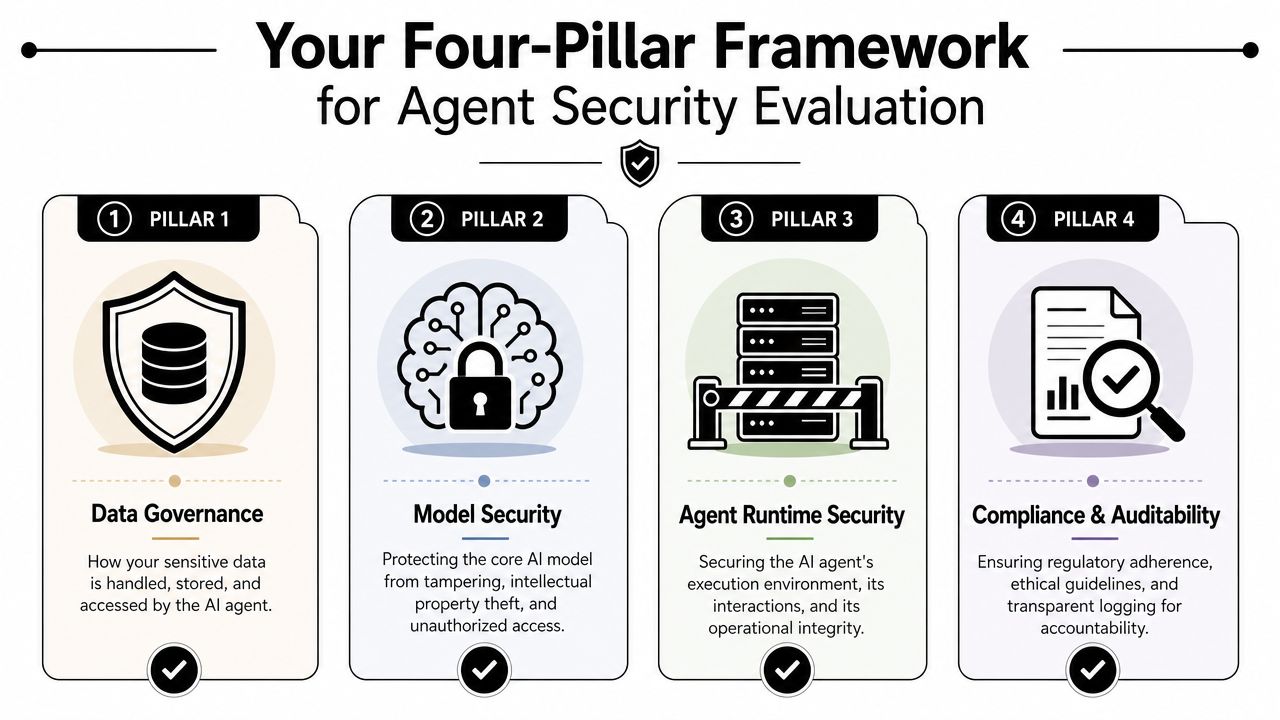
The fastest way to misjudge an AI agent is to review the model and ignore the system wrapped around it. Enterprise risk sits in the wrappers. Identity, connectors, logs, retention, approvals, and vendor operations decide whether an agent is containable or dangerous.
This four-pillar framework is designed for buyers, security teams, and technical leaders who need to assess an agent before it touches live customer, financial, or operational data. It is built around two areas that often get missed in early reviews. Continuous identity governance and data provenance.
Pillar one data governance and provenance
Start with the data path. You need to know what the agent can ingest, where that data is processed, what gets stored, how outputs are reused, and whether you can prove the origin of the information behind a decision.
For UK enterprises, this is a legal and operational question at the same time. If a vendor cannot explain residency, retention, deletion, encryption, and tenant isolation in plain terms, the deployment is not ready for regulated or sensitive workflows.
Ask vendors:
- Where is data processed and stored, and can you guarantee UK or approved regional handling where required?
- How is customer data separated by tenant, workflow, and connector?
- Can we set retention and deletion rules for prompts, uploaded files, logs, and generated outputs?
- Can we trace which source documents, systems, or messages influenced a specific output?
That last point matters more than many teams expect. If an agent recommends a pricing change, updates a case record, or drafts a response to a regulator, you need provenance. Without it, errors are hard to challenge and harder to investigate.
If you are comparing platforms instead of building from scratch, the builder model matters because governance controls are part of the product design. Teams reviewing orchestration options should examine this guide on choosing the best AI agent builder for your business, especially the trade-offs between flexibility and control.
Pillar two identity and access governance
Access reviews often stop at role-based access control. That is too shallow for autonomous systems. An agent needs its own governed identity, its own credentials, scoped permissions, and policy checks that continue after deployment.
Many pilots in production often fail when the team starts with narrow access, then adds connectors, shared secrets, and inherited user permissions to keep work moving. Over time, the agent becomes a service account with broad reach and weak ownership.
Use these questions:
- Does each agent have its own identity and credentials, or is it using a human account behind the scenes?
- Can permissions be restricted by task, tool, environment, and data class?
- Are access rights reviewed on a schedule, or do they persist indefinitely once granted?
- Can sensitive actions require approval, dual control, or policy checks at runtime?
Key management belongs in this pillar too. API tokens and connector secrets are a common failure point in agent deployments, especially where teams move quickly across dev and production. This guide on preventing LLM key leaks is a useful reference for evaluating how a platform stores, rotates, and limits sensitive credentials.
A strong platform treats every agent as a first-class identity that can be monitored, constrained, and shut down cleanly. Secure platforms such as Zenfox are a useful benchmark here because they are built around governed agent identities rather than inherited convenience.
Pillar three runtime traceability
Most incident reviews break down at the same point. Nobody can reconstruct what the agent saw, why it made a decision, which tools it called, and what changed downstream.
Good logging is not a dashboard screenshot. It is a usable event trail. Investigators need to follow a single business action from prompt to tool call to final write-back, with timestamps, approvals, policy decisions, and failure states intact.
Ask directly:
- Can we view a complete history of prompts, retrieved context, tool calls, approvals, and outputs?
- Are logs tamper-resistant and exportable to our SIEM or monitoring stack?
- Can we trace one action across the agent, connector, and target application without manual correlation?
- Can we distinguish between human input, system retrieval, and generated reasoning artifacts?
That level of traceability reduces incident cost. It also makes governance real. Without it, post-incident review turns into guesswork, and so does evidence for auditors, legal teams, and regulators.
Pillar four vendor operational maturity
A useful demo does not tell you how a vendor handles failure. Security posture shows up in patching discipline, incident response, support coverage, change control, customer isolation, and the quality of security answers when your team asks hard questions.
Buyers should test for operational maturity, not just feature depth. Ask who owns security, how vulnerabilities are disclosed, how customer-impacting incidents are communicated, and what support looks like outside business hours. If every answer routes through sales, that is a warning sign.
A practical checklist helps separate mature platforms from fast-moving but under-governed ones:
| Pillar | What good looks like | What should concern you |
|---|---|---|
| Data governance and provenance | Clear processing boundaries, tenant isolation, retention controls, and source traceability for outputs | Vague residency, unclear deletion, or no explanation of where output context came from |
| Identity and access governance | Separate agent identities, scoped credentials, runtime approvals, and recurring access reviews | Shared accounts, inherited user permissions, long-lived secrets |
| Runtime traceability | End-to-end logs across prompts, tool calls, approvals, and downstream actions | High-level activity views with limited forensic detail |
| Vendor operational maturity | Documented security processes, incident handling, enterprise support, and clear ownership | Security questions handled informally or only after escalation |
A serious review should create some friction. That is the point. If an agent platform appears easy to approve because the hard questions never get answered, the risk has not been removed. It has been deferred.
Implementing Essential Security Controls for AI Agents
Evaluation is only useful if it changes deployment practice. All too often, many programmes drift. The platform passes review, a pilot launches, and then convenience starts eroding the control model one connector at a time.
Start with identity not convenience
In UK enterprise deployments, a practical methodology is to treat each agent as a separately governed identity with least-privilege access and mandatory logging, with broad access inheritance identified as the main pitfall in this enterprise security guidance on AI agents. That principle is more important than any individual feature.
An agent should not be “the sales team agent” with one big basket of access. It should be a defined identity for a defined function. If one agent updates opportunity fields in HubSpot, that doesn't mean it should read every Gmail thread or write into every Slack channel.
The fastest way to create avoidable risk is to let agents inherit whatever the sponsoring user can reach. That looks efficient during setup. It becomes dangerous during runtime.
Controls that work in live environments
The controls below hold up better than blanket policy statements because they shape actual behaviour:
- Inventory every agent: Maintain a current register of what each agent does, which systems it connects to, and who owns it operationally.
- Classify reachable data: Record whether the agent can access personal data, customer records, documents, financial information, or regulated workflows.
- Use narrow credentials: Give each agent unique credentials with the smallest practical scope.
- Sandbox risky actions: Isolate document parsing, external content handling, and sensitive tool execution where possible.
- Require approval for irreversible tasks: Mass deletes, customer communications, status changes, and record overwrites should require confirmation.
- Monitor for anomalous behaviour: Watch for unusual access patterns, unexpected data movement, or privilege changes at runtime.
One weak spot that deserves explicit attention is secret handling. Agent ecosystems often involve connectors, service accounts, API keys, and orchestration layers. If your team is working through that problem, this guide on preventing LLM key leaks is a practical companion because credential exposure is still one of the fastest paths from configuration mistake to compromise.
Here's what doesn't work well:
- Shared service accounts: They blur accountability.
- Permanent broad permissions: They tend to become normal.
- Logging without review: Storing events is not the same as monitoring them.
- Human approval on every low-risk task: Teams bypass controls they find unusable.
Security controls have to match workflow reality. If the safe path is slower than the unofficial path, people will route around your architecture.
The best operating model is narrow by default and flexible by exception. Agents should earn access through explicit design, not pick it up by accident.
Addressing Advanced Threats and Governance Gaps
Once baseline controls are in place, two issues still cause trouble. They're less visible during procurement and far more visible after deployment. One is permission drift. The other is trust in inputs that look legitimate.
The identity governance gap
Most organisations know they should set least privilege at deployment. Far fewer can prove what an agent can access three months later.
That gap matters because current guidance increasingly treats agents as privileged digital identities that require continuous monitoring of prompts, decisions, and resource-access patterns, a concern highlighted in Recorded Future's research on emerging enterprise security risks of AI. The problem is not merely bad setup. It's drift.
Drift happens when:
- New connectors are added for convenience during a project
- Roles expand informally because nobody wants to rebuild a workflow
- Approvals are relaxed after the pilot phase to reduce friction
- Ownership becomes unclear when an agent outlives the original team
A mature governance model treats agent identity the way mature organisations treat privileged human access. It gets reviewed, monitored, challenged, and, when needed, reduced. If you're deploying into service-heavy operational environments, this analysis of ServiceNow AI agents is relevant because the workflow value rises quickly, and so does the need for strong identity boundaries.
A practical review cadence should answer four questions:
| Governance question | Why it matters |
|---|---|
| What can this agent access today? | Prevents assumptions based on outdated design documents |
| Why does it still need that access? | Stops convenience-based permission creep |
| What changed since the last review? | Exposes drift before it becomes normal |
| What alerts fire if behaviour changes suddenly? | Gives operations a chance to contain misuse early |
When the input is authorised but unsafe
The harder problem is data provenance. Security teams are good at blocking obviously untrusted sources. Agents create a new challenge because some dangerous inputs come through approved channels.
An invoice from a known supplier. A PDF uploaded by a colleague. A Slack message in a legitimate workspace. An email from a long-standing customer. All of these can be authorised sources. That does not mean the content is safe for an agent to act on.
The failure mode usually looks like this: the agent reads content, extracts instructions or context, and then calls tools based on that material. If the content contains hidden prompt injection, misleading instructions, or embedded payloads, the agent may treat tainted input as business truth.
The answer isn't to stop agents from reading business context. That would remove much of their value. The answer is to separate reading from acting more carefully.
Useful safeguards include:
- Content filtering before tool use: Inspect documents and messages before allowing them to influence high-risk actions.
- Sandboxed document handling: Parse files in isolated environments before the main workflow sees them.
- Tool boundary validation: Confirm that content from one source cannot trigger broad actions in another system without proper oversight.
- Confidence thresholds with escalation: If provenance is unclear, the agent should ask for review rather than improvise.
- Destination controls: Limit where extracted data can be written or posted.
Approved source does not equal trusted instruction.
This is why static policy checklists age badly in agent environments. They assume a fixed relationship between identity, content, and action. Agents break that assumption because context is fluid. A message can be legitimate in origin and still unsafe in effect. Governance has to follow runtime behaviour, not just setup paperwork.
Choosing a Secure Platform vs DIY Solutions
At some point, every enterprise has to choose between building its own agent stack and adopting a managed platform. This is less about ideology than operational burden. DIY gives maximum flexibility. It also gives you maximum accountability for identity, logging, policy, secrets, connectors, runtime isolation, and compliance interpretation.
Managed platforms reduce that burden, but only if their controls are visible and usable. A platform isn't safer just because it's packaged. It's safer if it gives you strong defaults, clear boundaries, and evidence you can work with.
A simple comparison makes the trade-off clearer.
Platform vs DIY AI Agents A Security Comparison
| Security Factor | Managed Enterprise Platform (e.g., Zenfox) | DIY / Open-Source Solution |
|---|---|---|
| Identity model | Often includes structured agent accounts, role controls, and platform-level governance | You design and maintain identity boundaries yourself |
| Logging and audit trails | Usually built into the product workflow | Often fragmented across orchestration, cloud, and apps |
| Compliance support | May include documented security controls and enterprise deployment options | Your team maps and proves controls independently |
| Speed to secure deployment | Faster if the platform already supports required controls | Slower because every integration needs review |
| Customisation | Constrained by product boundaries | High, but with greater security engineering burden |
| Incident response visibility | Better if prompt, action, and connector events are correlated | Depends on how well you instrument the stack |
| Long-term maintenance | Shared with vendor | Entirely your responsibility |
For many organisations, the true cost of DIY isn't the initial build. It's the ongoing work of keeping agent identities governed, permissions narrow, connectors patched, and logs usable during an incident.
Secure managed platforms can make sense. Zenfox.ai is one example. It provides an AI automation assistant that connects business tools, keeps an activity log, and offers enterprise security features including SOC 2 certification, GDPR alignment, AES-256 encryption, and options such as data enclaves and on-prem storage, according to the publisher's product information. That doesn't remove your governance obligations, but it can reduce how much infrastructure your own team has to assemble and maintain.
DIY still fits some teams, especially those with strong internal security engineering and unusual workflow requirements. But most organisations should be honest about their appetite for sustaining an agent control plane over time. If your architecture decisions also depend on how much autonomy you want from workflows, this comparison of agentic AI vs AI agents can help frame the operating model discussion.
The safest choice is usually the one your team can govern consistently, not the one that looks most flexible in a prototype.
If you're evaluating how to automate workflows without weakening data security, Zenfox.ai is worth a look. Review it the same way you'd review any enterprise agent platform: inspect the identity model, logging depth, deployment options, and data controls, then decide whether the operational burden fits your risk tolerance.